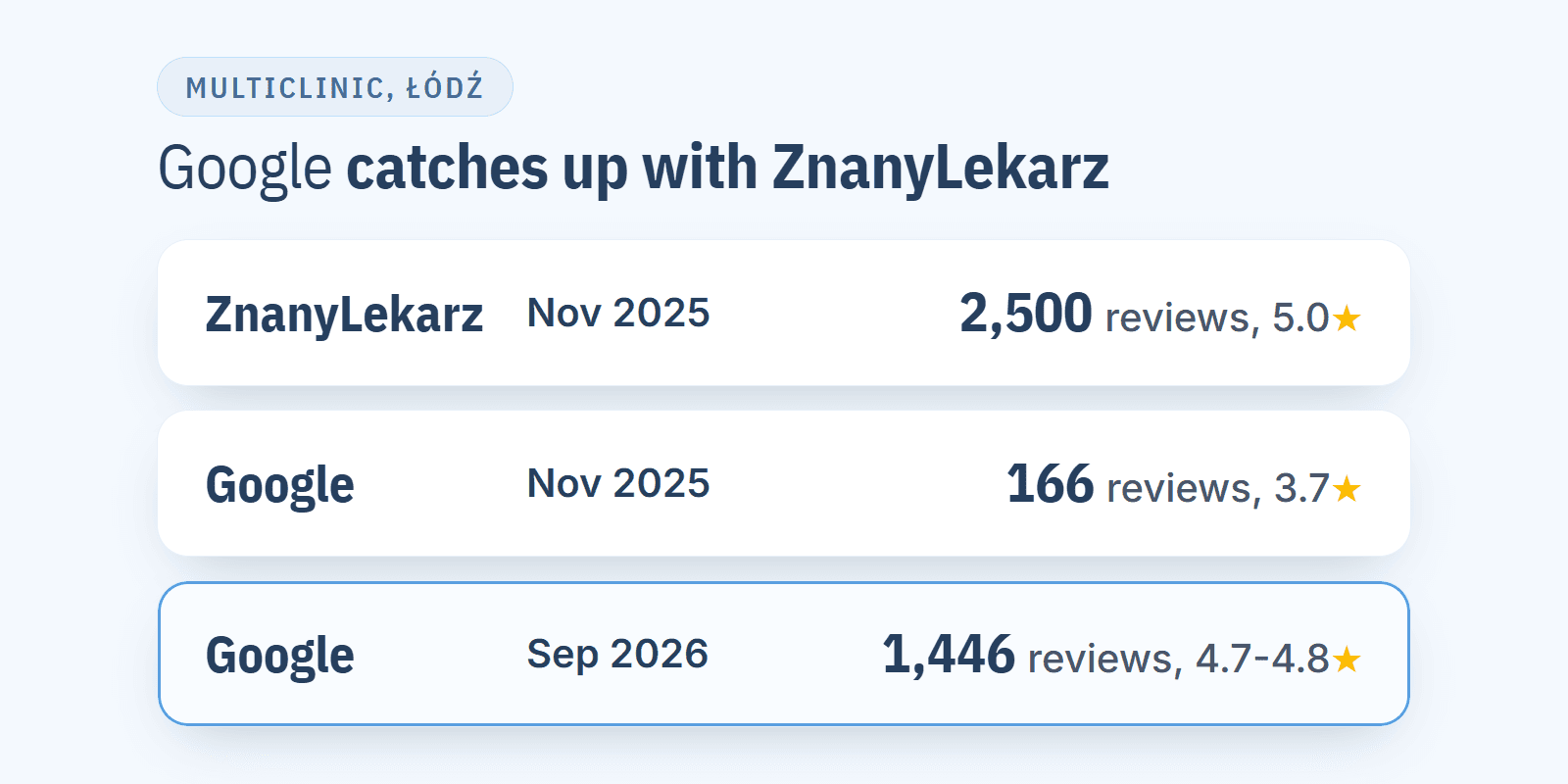
MultiClinic, two private clinics in Łódź, Poland, had 2,500 reviews averaging 5.0 on ZnanyLekarz, the Polish doctor booking portal. On Google, the two clinics had 166 reviews between them, averaging 3.7. From November 2025 to September 2026 the Google review count grew to 1,446, and the average rose to 4.7 and 4.8★.
About the client
MultiClinic runs 2 private medical centers in Łódź: one in Księży Młyn and one in Chojny. It has close to 60 doctors and handles about 3,000 visits a month. Repto has been running at both clinics since November 2025.
Why did the booking portal have 2,500 reviews and Google only 166?
Because ZnanyLekarz asks the patient for a review after the visit, and Google doesn't ask anyone. Same patients, same clinics, and a completely different picture on each site.
On Google, reviews came mostly from people who were unhappy about something, while happy patients usually forgot to leave one. That's how you get 5.0 on one site and 3.7 on the other. It's hard to find better proof that the care itself was never the problem.
The management team had seen for a while that the low review count was hurting the clinics' visibility on Google Maps. And a patient looking for a clinic on Google Maps sees only the Google stars.
How was Repto set up?
API integration. We connected Repto to MultiClinic's clinic software, so the team doesn't import anything by hand or have to remember anything. (Repto also connects automatically to other clinics' practice management software, or a clinic can upload a CSV or Excel export of its visits instead.)
An SMS the day after the visit. Every day, Repto sends the previous day's patients a personalized SMS asking for a review, with a unique link to rate the visit.
A/B testing the wording. After we tested several versions of the message, 15% of patients now open the link in the SMS.
Critical feedback goes to customer service. When a patient is unhappy, their comments reach MultiClinic's customer service team first.
I walk through the whole process step by step in my guide to automated Google review collection.
How did the review count grow?
The first month brought +171 reviews, and after that the pace settled at 100-150 reviews a month. At the start, in November 2025, the two clinics had 166 reviews combined. From there, the total grew like this:
January 2026: 481, so +315 in just over two months
March 2026: 757, so +591 in under 5 months
July 2026: 1,123
September 2026: 1,446, so +1,280 since the start
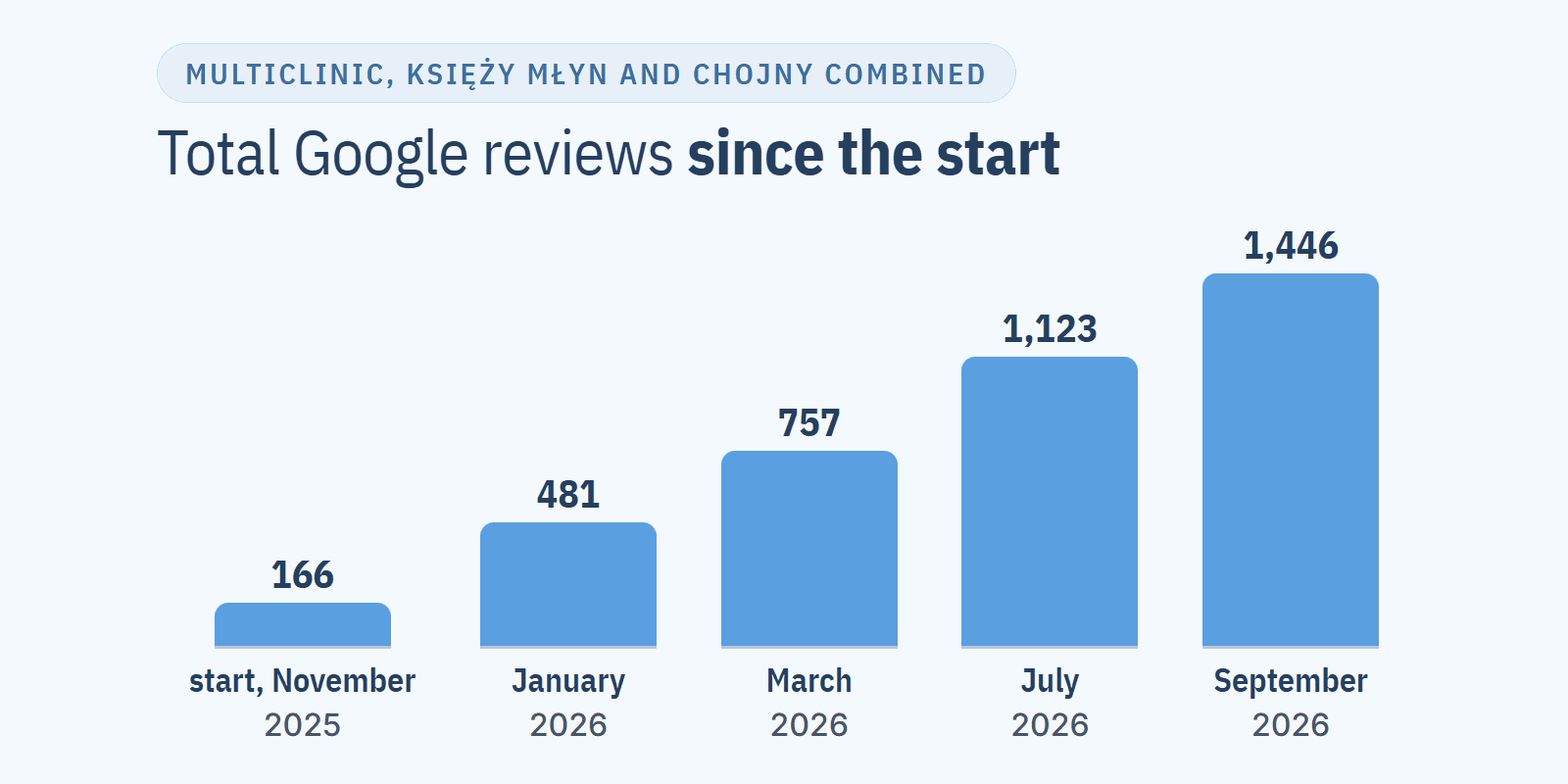
Bar chart of MultiClinic's combined Google reviews: 166 in November 2025, 481 in January 2026, 757 in March 2026, 1,123 in July 2026 and 1,446 in September 2026
How many reviews does each clinic have now?
As of September 2026:
Księży Młyn: 120 → 876 reviews (+756), average 3.7 → 4.7★
Chojny: 46 → 570 reviews (+524), average 3.7 → 4.8★
Combined: 166 → 1,446 reviews (+1,280), 8.7 times the starting count
Chojny started with 46 reviews, less than half of what Księży Młyn had. By September 2026 it had more than 12 times its starting count and a higher average than Księży Młyn, although Księży Młyn collected more new reviews (+756 vs +524).
Has the Google rating caught up with the booking portal?
Almost. At the start, ZnanyLekarz showed 5.0 and Google 3.7, a gap of 1.3 stars. As of September 2026 the clinics have 4.7 and 4.8 on Google, which is 0.2-0.3 below that 5.0. The rest of the gap comes from old reviews: they're still on the profile and still count towards the average. Every new month of reviews makes them weigh less.
More important than the average itself: the Google ratings finally show the same thing patients say on ZnanyLekarz. A patient comparing clinics on Google Maps now sees 1,446 reviews instead of 166.
What does this mean for clinics with strong booking-portal reviews?
If a clinic has hundreds of reviews on a booking portal and a handful on Google, that's good news: the happy patients are already there; all that's missing is someone asking them for a Google review. In my view, that's the easiest start there is. MultiClinic needed just over two months to go from 166 reviews to 481, and new reviews have kept coming in ever since.
It's harder when a weak Google average matches the ratings on other sites. Then asking for reviews isn't enough, and the clinic first has to fix whatever patients are complaining about.
What does MultiClinic do with critical ratings?
It contacts the patient. Patients appreciate a quick response, and in many cases the problem gets solved.
Critical feedback goes first to someone who can call the patient back. A Google Business Profile can't call anyone back. For the critical reviews that still end up on Google, my guide to responding to negative patient reviews shows how to reply, with examples.
What the client says
"Working with Repto has really changed a lot in our day-to-day work.
For years, it was mostly unhappy people who spoke up on Google, and happy patients rarely left reviews. Repto changed that. Today our online ratings finally reflect what we hear from patients every day.
We also really value being in touch with the people who leave reviews, including the critical ones. We can call them, talk, explain the situation, and sometimes simply apologize. We draw important lessons from every one of those conversations and make real improvements.
We'd like to thank all our patients for their reviews, both the positive ones and the harder ones. To us, it's a sign that our work matters."
Karolina Szabert-Kwarciak, CEO of MultiClinic
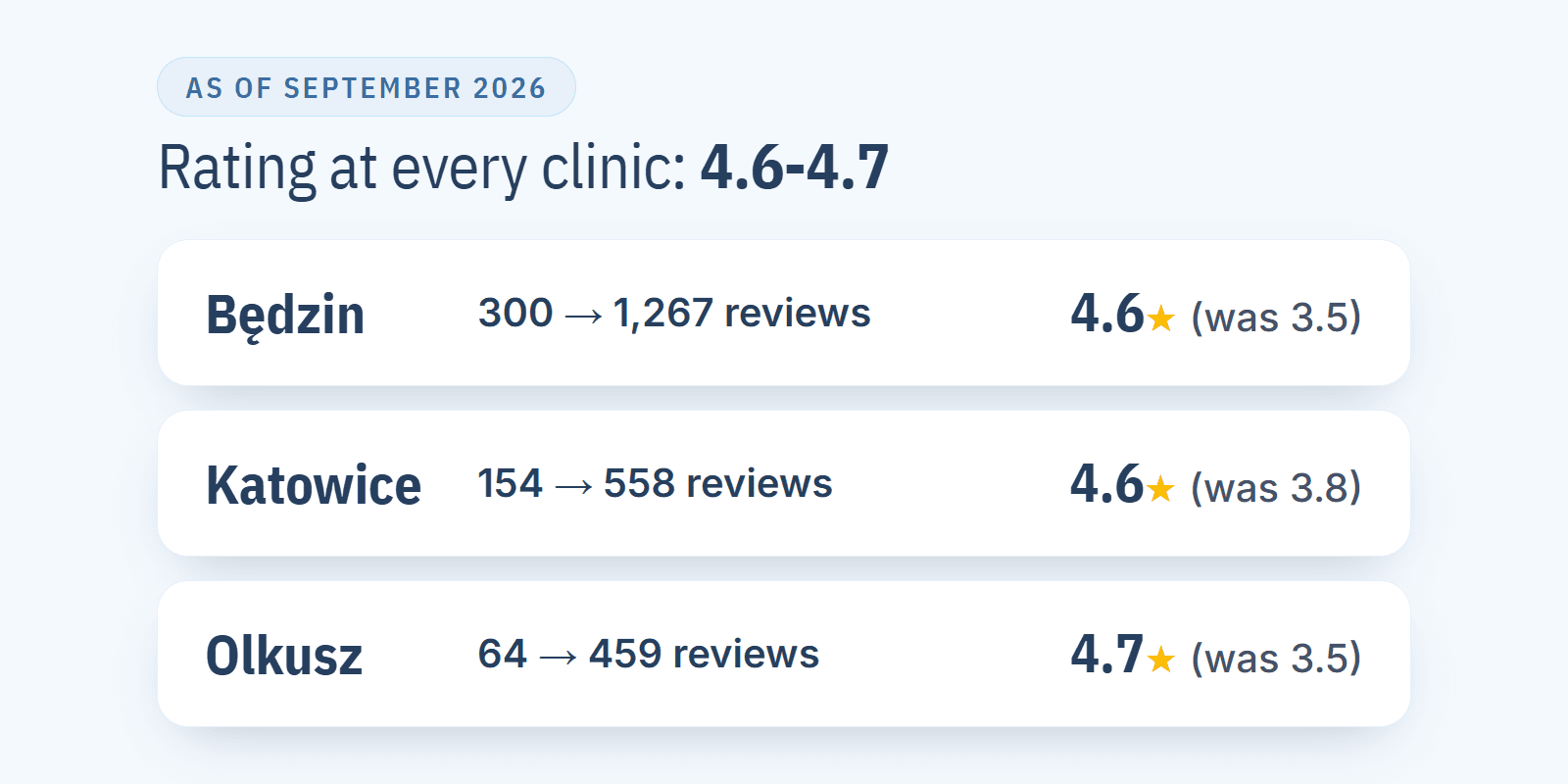
Other clinic groups using Repto: three clinics in Będzin, Katowice and Olkusz collected 1,766 new reviews, and a group in Warsaw and Płock has been collecting reviews for over a year. Combined results for all Repto clients are on our results page.