A Google review can be removed only by the person who wrote it or by Google, and Google steps in only when the review breaks its policies: it's spam or fake engagement, contains profanity, threats or someone else's personal data, or isn't about your clinic at all. As the profile owner, you can report a review like that for free. A review that's simply critical stays up, even if it feels unfair. There is no third way, and that includes firms that charge money for removing reviews.
I run Repto, a company that helps clinics collect new reviews from real patients. We don't remove reviews, but the clinics that book a call with me are often the ones that have just had several negative reviews in a short time. Why clinics have so few reviews, how to collect them and how to reply to them is covered in my guide to Google reviews for medical practices.
Can you remove a Google review?
Yes, but only in two situations: the author deletes it, or Google decides it breaks the rules for user content. The owner of a Google Business Profile has no "delete" button. You can report the review and you can reply to it.
Google doesn't remove a review just because the owner disagrees with it, and it doesn't settle disputes between a business and its customers (Google Business Profile Help). So a review saying "I waited 40 minutes and the doctor kept staring at the screen" doesn't break any rule, and Google won't take it down, even if the calendar shows the appointment started on time. I know that hurts.
Which reviews does Google remove?
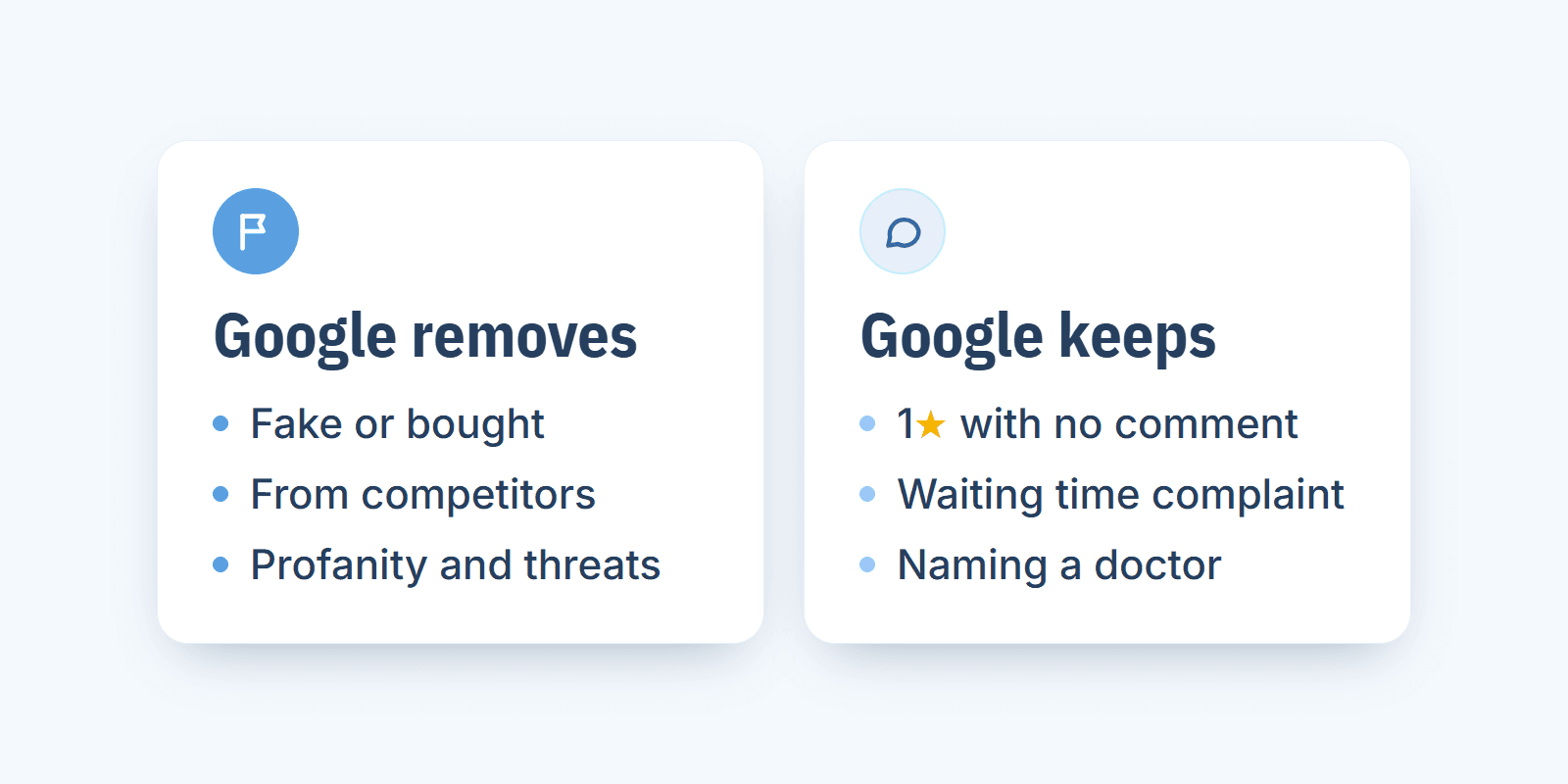
Google removes reviews that break its content rules for Google Maps (Maps user-generated content policy, as of October 2026). For a clinic, these are the ones that usually apply:
Fake engagement. Reviews that inflate the count artificially: one patient leaves several reviews from different accounts, or asks family and friends to "rate" a clinic they've never been to. Bought reviews belong here too.
Conflict of interest. A review from a competing clinic, or from a former employee settling a score with their employer.
Off-topic content. A review meant for a different clinic with a similar name, or a political comment that has nothing to do with the visit.
Harassment and threats. This includes posting private details, such as a doctor's home address.
Offensive content and profanity. Including unfounded accusations of a crime or dishonesty.
Personal data without consent. With one caveat that matters for clinics: Google allows reviews to name people associated with the business, so a doctor's name in a review isn't a violation on its own.
Which reviews won't Google remove?
The ones that are unpleasant but stay within the rules. A 1★ rating with no comment, or a complaint about the queue, the tone at the front desk or the price of a visit, is an ordinary customer review as far as Google is concerned.
The tricky case is a review from someone who isn't in your patient records. The clinic knows that visit never happened, but Google can't see your records and has no way to check. It's still worth reporting, under fake engagement, but be prepared for Google to leave it up.
How do you report a Google review for removal?
The official route for the owner is the review management tool for Google Business Profile. Step by step:
- 1.
Open the review management tool and sign in with the account that manages your clinic's profile.
- 2.
Select your clinic, then choose the option to report a new review for removal.
- 3.
Click "Report" next to the review and pick the reason, such as spam or profanity.
- 4.
Submit the report and check its status in the same tool.
Each report gets one of three statuses: decision pending, reviewed with no policy violation, or escalated to a more senior reviewer. If Google decides the review doesn't break its rules, you can file one appeal, covering up to 10 reviews at once. The decision arrives by email.
Reporting from the public profile
Anyone with a Google account can report a review, not only the profile owner: in Google Maps there's a flag icon or a menu with a "Report review" option next to each review. In a few cases I've seen this route work better than the dashboard: several people reported the review from the profile, each from their own account, for example clinic staff and their families, and Google removed it.
Google assesses every report against the same rules and asks people not to report reviews just because they disagree with them. So this route makes sense for reviews that genuinely break the rules: spam, profanity, or reviews from people who have never been to the clinic. If you run several locations, you report separately for each one, because each location has its own profile.
How long does it take to remove a Google review?
Google usually takes a few days to process a report, and an appeal doesn't guarantee a different outcome. If the review stays, it stays for good, unless the author changes their mind.
Can you ask a patient to remove a review?
You can, and in most cases reaching out to the patient is the best move: a short public reply, and the matter cleared up in private. A few times I've seen a clinic manager contact a patient after a negative review, the issue got sorted out, and the patient deleted the review themselves.
The decision always stays with the patient, because only the author can edit or delete a review (Google Maps Help).
There is one hard line. Google's policies forbid offering any benefit in exchange for changing or removing a negative review: a discount, a free check-up, a refund for the visit. "Take your review down and your next visit is on us" is exactly the scenario the rules describe.
How do you reply to a negative review without breaching patient confidentiality?
Write it so that the reply reveals nothing about the patient, not even that they were ever seen at your clinic. Doctors are bound by medical confidentiality. In Poland, for example, Article 40 of the Act on the Professions of Physician and Dentist requires doctors to keep confidential any patient information they learn while practicing. Patient consent is one of the exceptions, and a Google review isn't consent. In the EU, the GDPR applies on top of that.
It's easy to make a mistake that looks harmless: "Ms Smith, our records show you were 20 minutes late, and the ultrasound was done as per your referral." In one sentence the clinic has confirmed the visit, the type of scan and the referral. A version that reveals nothing about the patient:
Thank you for your feedback. We can't discuss the details of any visit in public, because we're bound by medical confidentiality. Please contact our clinic manager on [phone number] so we can sort this out.
Your reply will be read later by patients who are still choosing a clinic, so you're really writing it for them. A calm tone and an invitation to talk go down better with them than an argument. You'll find more examples in the posts on responding to negative patient reviews and Google review response templates.
How much does it cost to remove a Google review?
Nothing.
Reporting a review to Google is free, and you can do it yourself, from the dashboard or from the public profile. In Poland, two review removal firms on the first page of Google charge PLN 199-250 net per removed review (their price lists, as of 15 October 2026), but that isn't a good approach.
Is it worth paying a firm to remove reviews?
No.
As I said at the start, a review can be removed only by its author or by Google. A review removal firm has no third way: it clicks the same "Report" button you have in your dashboard, and Google makes the call either way. Anyone who promises to remove every negative review is selling you something they don't have, and to me that's plain fraud.
On top of that, a clinic has more to lose than a shop:
Your profile can suffer. If the "removal" is a series of automated reports from many accounts and Google notices, it may treat it as manipulation. If that happens, it's your profile that pays the price, and the firm will still have sent its invoice.
Medical confidentiality. A firm may ask for context to "analyze" the review. Any information about who the author is and what happened during the visit is patient data handed to someone outside the clinic. For comparison, Repto receives only the patient's first name (no surname), phone number and visit date.
Methods that break the rules. Additional accounts, adding positive reviews to bury a negative one, or pressuring the author with the promise of a benefit all break Google's rules. What happens when you buy reviews is covered in the post on buying Google reviews.
If a review genuinely breaks the rules, report it yourself, as described above. With ordinary criticism, your money and time are better spent on what actually raises your average: new reviews from happy patients (more on that below).
Can a court order a review to be removed?
It can, but only when the review breaks the law, for example by infringing someone's personal rights. A harsh opinion on its own isn't enough. A Polish case shows this well: a gynecologist sued a doctor booking portal to have a patient's unfavourable review taken down. The Regional Court in Warsaw dismissed the claim (the judgment was not yet final when the Polish medical portal mp.pl reported it in July 2015).
The reasoning: the review wasn't vulgar or offensive, and the portal only has to remove content once it receives credible information that the content breaks the law. The court put it briefly: a doctor "has to accept being judged, even harshly".
The same court noted that a lawsuit against the author of the review might have ended differently. In that case, it would be up to the author to show that their accusations had grounds.
For content that breaks the law, Google has a separate form for reporting content for legal reasons. That's a route for you and a lawyer, though, meant for serious matters such as defamation. A review about the queue doesn't belong there.
What do you do about a wave of negative reviews?
Make sure happy patients start leaving reviews too. You most likely won't get three 1★ reviews removed, but you can bury them under new, good ones.
What I hear from clinics most often is that angry patients remember to leave a review and happy ones forget. I also hear: "the only reviews we get on their own are negative". You can see it clearly on booking portals that ask the patient for a review after the visit: the clinics I talk to often have 2,000-3,000 reviews there and 40-50 on Google, because Google doesn't ask anyone.
That's why the best response to a wave of negative reviews is asking every patient for a review, ideally by text message the day after the visit, while they still remember it well. You'll find ready-to-use texts for those messages in the review request SMS templates.
How many new reviews do you need? Say a clinic has 50 reviews with a 4.0 average. In one week, three 1★ reviews appear and the average drops to 3.8. To get back to 4.0, it needs 9 new 5★ reviews. Once the average is above 4, even a 4★ review pulls it down a little, so it's mostly the five-star ones that count.
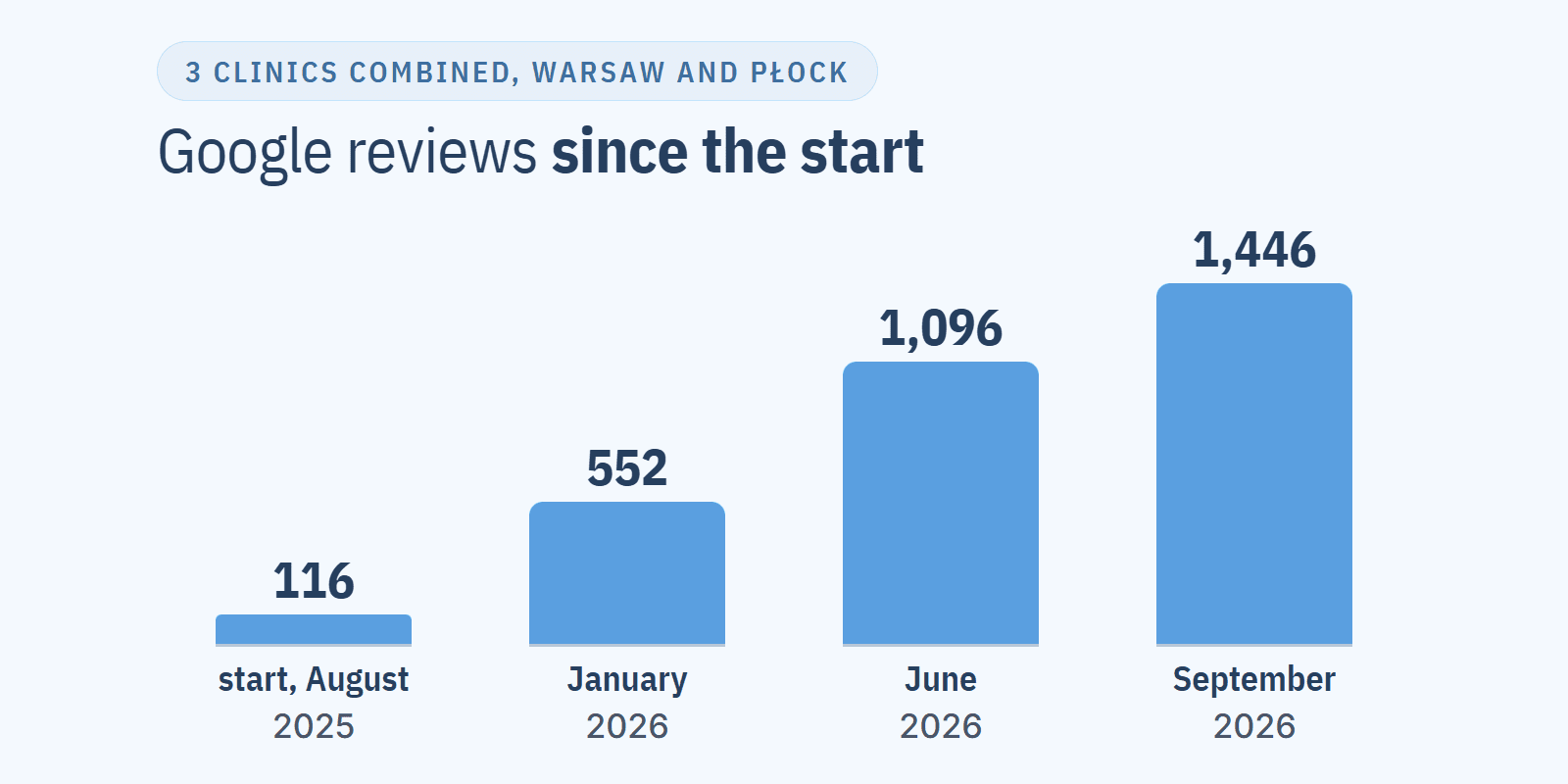
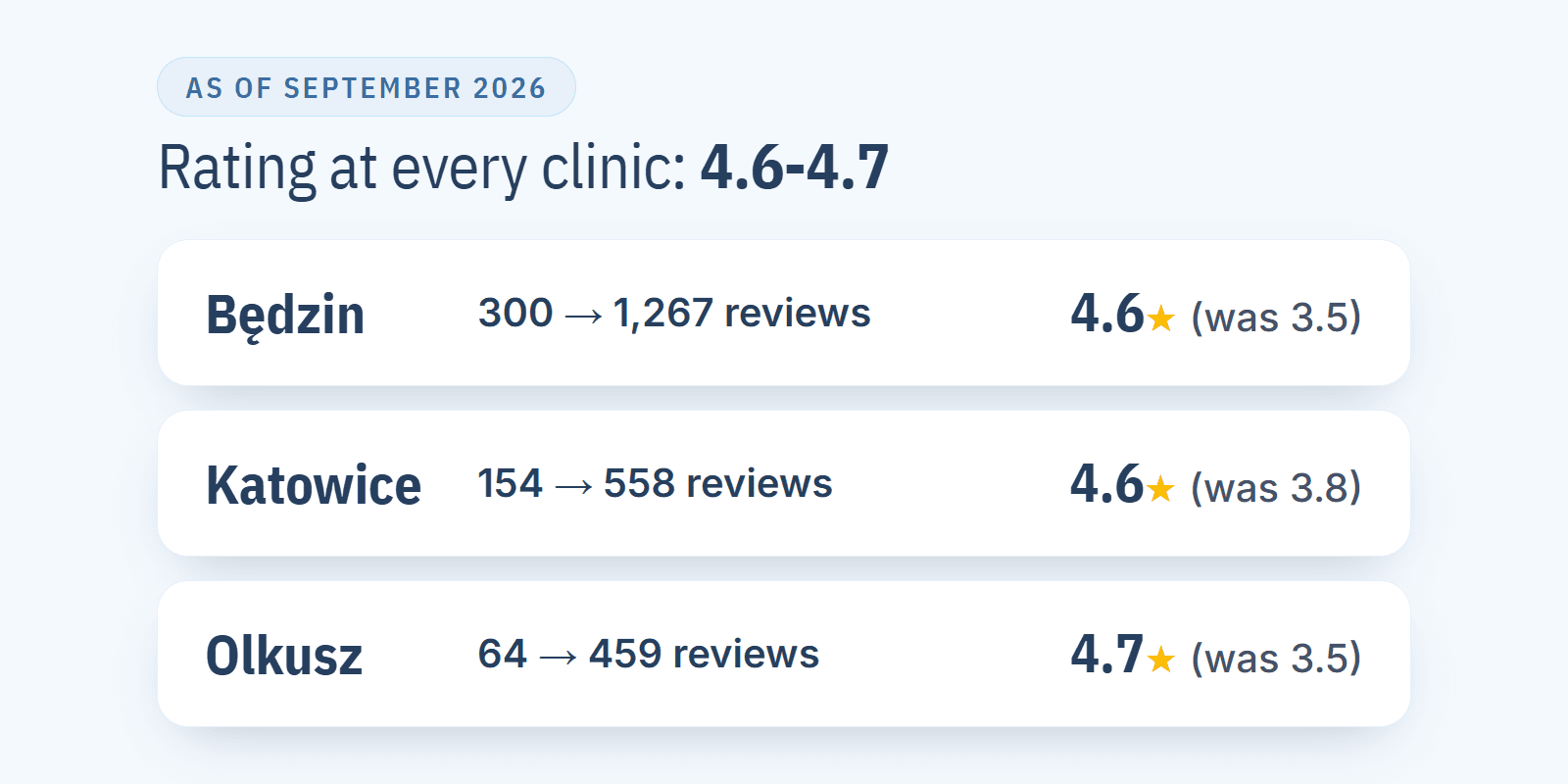
This is how it looked for our clients: MultiClinic started with 166 Google reviews and a 3.7 average. A group of three clinics started with 518 reviews and an average of about 3.5. Both raised their count and their average by collecting new reviews from real patients (the numbers are in the case studies). Nobody removed anything.
Repto is an automated review collection system that sends the patient a text message the day after the visit. How it works, and how it compares with a QR code or asking at the front desk, is covered in the post on automated Google review collection.
FAQ
Can a business owner delete a Google review?
No. The profile owner can report a review and reply to it. Only the author can delete it, or Google, if the review breaks the rules. The same goes for a photo a patient has added. How to report one is covered in the guide on how to remove a photo from a Google Business Profile.
Will Google remove a 1★ review with no comment?
Usually not, because a rating without text doesn't break the rules. The exception is a burst of such ratings in a short time from accounts with no history: you can report those as fake engagement.
Does a review that names a doctor break Google's rules?
No, Google's rules allow reviews to name people associated with the business. A review only qualifies for removal if it contains threats, profanity or private details, such as a home address.
How long does Google take to process a review report?
Usually a few days. If the report is rejected, you can file one appeal, covering up to 10 reviews at once.
What if a competitor wrote the review?
Report it for conflict of interest and include anything that proves it in your appeal, for example the account's link to another clinic. If the review makes false accusations, talk to a lawyer.
Can you offer a patient a discount to change their review?
No. Google's rules forbid offering a benefit in exchange for changing or removing a negative review. Talking to the patient and clearing things up is fine; the decision about the review stays with the patient.
Want to know how many 5★ reviews stand between your clinic and a 4.8 average? The Google review calculator works it out for you. If you'd rather talk it through, book a short call with us.