A clinic gets new patients from 7 channels: its Google Business Profile with reviews, booking portals, Google Ads, Facebook and Instagram ads, its website and SEO, referrals, and partnerships with employers and other doctors. Each channel has its own cost per new patient and its own lead time before the first patients turn up.
Without that number, the owner splits the budget by gut feeling, and the biggest share usually goes to whichever channel's sales rep calls most often. What a clinic may and may not do in advertising is covered in my guide to medical practice marketing.
Where does a clinic get new patients?
From the places where patients look for a doctor, and from people they trust. The first group is Google Maps, Google Search, booking portals and ads; the second is family, friends and other doctors.
Google Business Profile and reviews: the patient types "dermatologist" or "abdominal ultrasound" and picks a clinic in Google Maps.
Booking portals: the patient looks for a doctor and books the appointment on the portal.
Google Ads: an ad above the search results, seen by someone who needs the service right now.
Facebook and Instagram: ads shown to people in your area who aren't looking for a doctor yet.
Website and SEO: the patient finds your website through Google, for example via an article on treating acne.
Referrals: a patient brings along a family member or a friend.
Partnerships: contracts with employers (occupational health checks, screening packages) and referrals from doctors and clinics that don't compete with you.
A patient usually comes across a clinic in several places, one after another: they see an ad, then check the reviews in Google Maps, and only then pick up the phone. That's why Google reviews affect the results of every other channel.
Which channel is the cheapest, and which works the fastest?
Google Ads works the fastest, while referrals and your Google Business Profile cost the least, because they need no ad budget. SEO takes the longest to pay off. I'm not giving amounts, because the cost per patient depends on the city, the service and the competition, so the same channel in a capital city and in a small town is two different bills.
The channels from the fastest to the slowest, with referrals at the end, since you can't set their pace:
Google Ads: you pay per click (often an agency too), and Google reviews most ads within one business day (Google Ads Help), so the first calls come in after a few days.
Booking portals: you usually pay a subscription per doctor, often plus a fee for each new patient's visit, and the first bookings tend to appear after a few days.
Facebook and Instagram: you pay for the ads and for photos and videos, and the first patients take a few weeks to arrive.
Google Business Profile and reviews: it costs you your team's time or a tool for review requests, and the effect shows after a few weeks.
Partnerships with employers and doctors: it costs you time spent in meetings and usually a discount in the contract, and months pass between the first conversation and the first patients.
Website and SEO: you pay for the articles and for the time of the doctor who checks them, sometimes for an agency too, and the results come after several months.
Referrals: they cost nothing, but no budget will speed them up.
Even so, I'd start with the Google profile and the website, slower as they are, because ads send patients to your profile and website anyway, and a weak profile wastes part of the ad budget.
How do you calculate patient acquisition cost?
Divide what you spent on a channel in a given month by the number of new patients who came from it:
patient acquisition cost = spend on the channel / number of new patients from that channel
Spend includes everything the channel costs: the ad budget, the subscription, the agency's invoice and the time of the staff member who looks after it. Count only patients who actually came in for a visit, not calls and clicks that never turned into a booking.
A worked example
The numbers below are made up for the example and given in Polish zloty (PLN). A clinic offering dermatology and aesthetic medicine looks at one month:
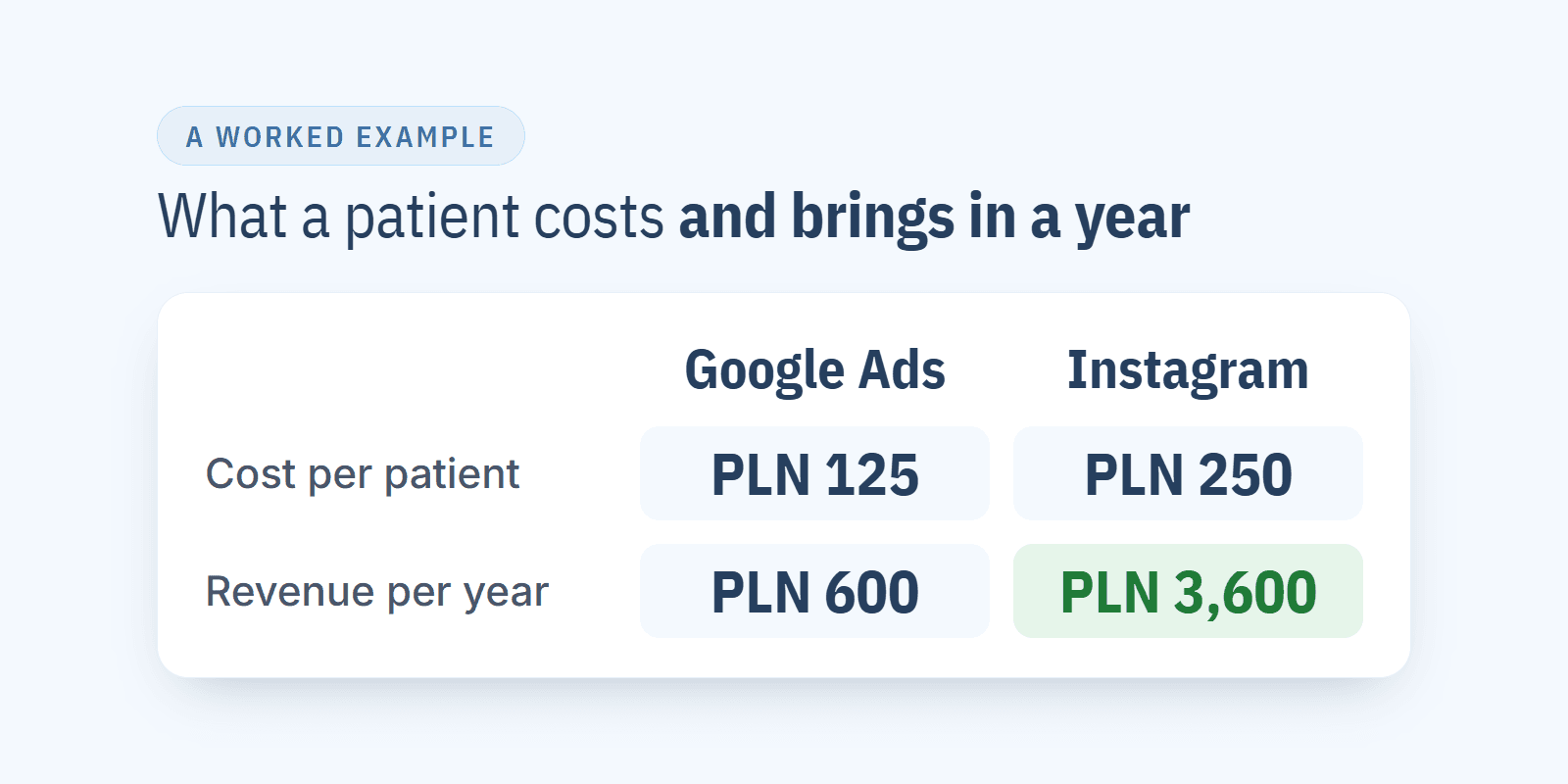
Google Ads: PLN 4,000 of ad budget and PLN 1,000 for the agency, 40 new patients, so PLN 125 per patient.
Instagram and Facebook: PLN 2,500 of ad budget, 10 new patients, so PLN 250 per patient.
Referrals: PLN 0, 25 new patients.
Instagram looks like the most expensive channel here. But if Instagram mostly brings in patients for aesthetic treatments and Google Ads brings in patients for a consultation, the picture can flip. That's why you compare the cost per patient with how much the patient spends at your clinic.
How much can a new patient cost?
Up to the point where the clinic still makes money on them. You work out a patient's value from the revenue their visits bring in over a year:
patient value = average revenue per visit × number of visits per year
In the same example, the patient from Google Ads comes in for a PLN 300 consultation and comes back once more, so they spend PLN 600 in a year. The patient from Instagram has a PLN 1,200 treatment and comes in 3 times a year, so she spends PLN 3,600. The Instagram patient, acquired for PLN 250, is the better deal here than the Google Ads patient acquired for PLN 125.
Revenue isn't profit yet, so from the patient's value you subtract what their visits cost you (the doctor's pay, materials). I'd keep a channel going as long as the patient acquisition cost stays below the profit from that patient's visits in the first year.
How do you find out where a patient came from?
The simplest way is to ask at the front desk and record the answer in the system at the first visit. Without that, you can't calculate the cost per patient, because many patients book by phone, and a phone call leaves no trace in your website analytics.
A question at the front desk: "How did you hear about us?", with a list of answers to tick in your practice management software (Google, booking portal, Facebook and Instagram, referral, employer, other).
Calls from your Google profile: Google Business Profile shows how many people called straight from your profile.
Online bookings: the booking system on your website and each booking portal's dashboard show separately how many patients booked through each of them.
Links in ads: UTM tags in your links, so your website analytics show which campaign brought the patient to the site or to an online booking.
A list of answers to tick works much better than free text, because after a month nobody is going to add up 300 answers saying "the internet".
What drives the cost per patient in each channel?
In paid channels, it's how many clicks and calls end in a visit; in free ones, it's the time someone at the clinic spends on them.
Google Business Profile and reviews
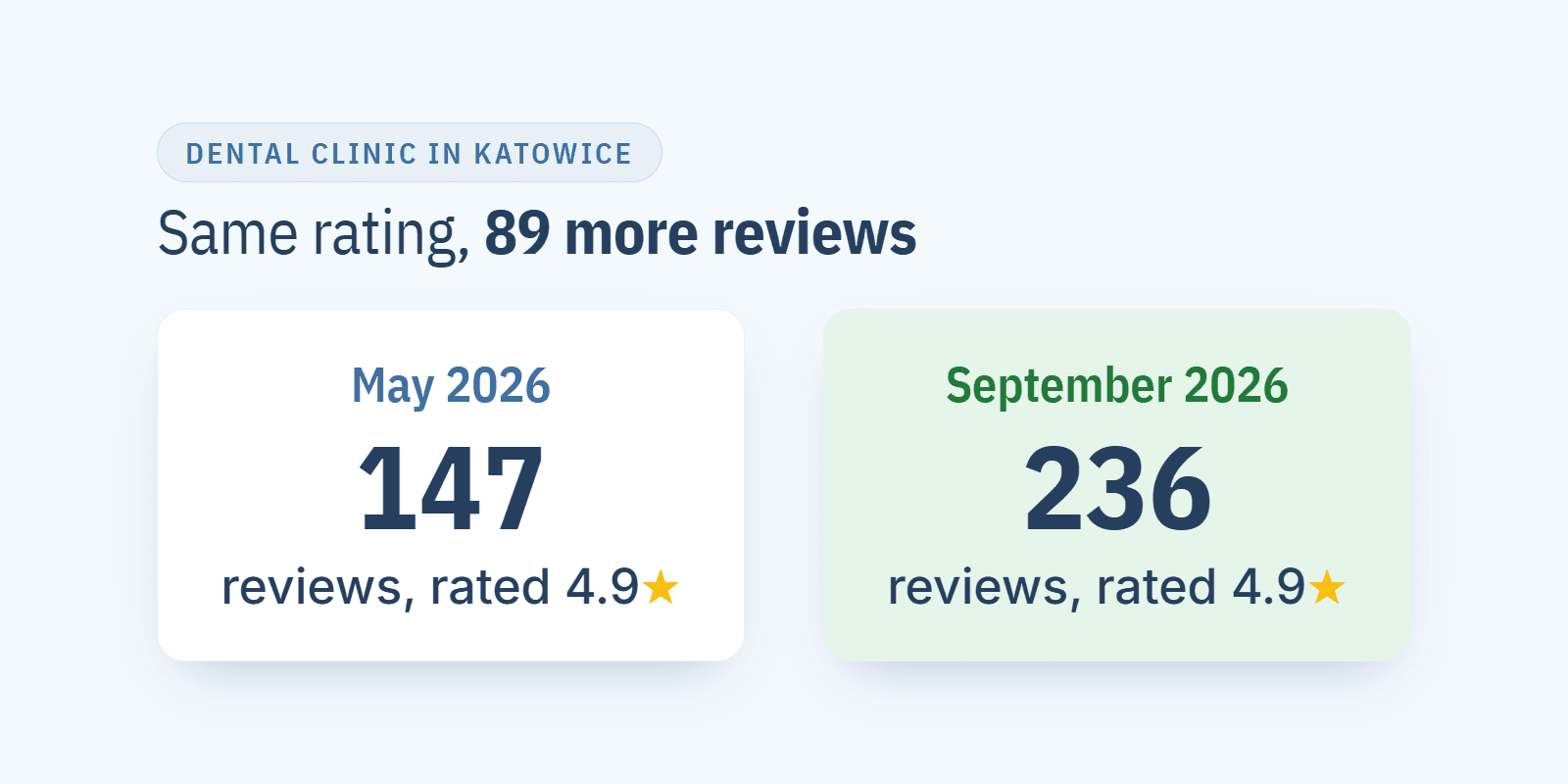
The profile is free, and in Google Maps patients choose mainly by rating and number of reviews. In an analysis of 653 public Google profiles of medical facilities in Kraków, Poland, that we ran at Repto (data as of 20 October 2026), the median was 57 reviews and about 1 new review a month. So 4-5 new reviews a month is enough to collect several times more than a typical profile in Kraków. With a request sent after every visit, the pace is completely different: a group of three multispecialty clinics collects over 100 new reviews a month across its three profiles combined. How your profile and reviews translate into your position in Google Maps is covered in my article on local marketing.
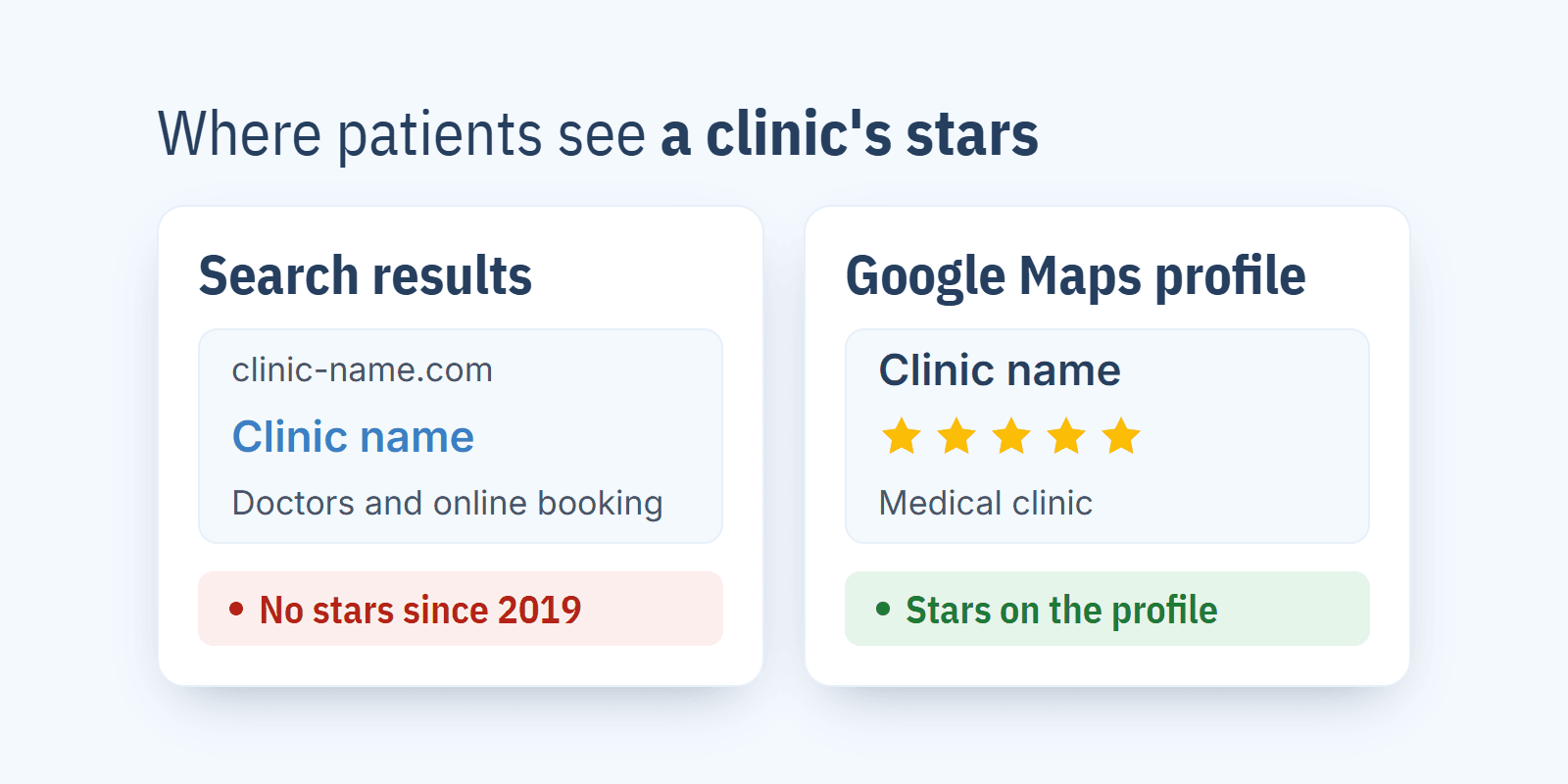
The problem is that happy patients usually don't leave a review on their own. Clinics I talk to in Poland often have 2,000-3,000 reviews on a booking portal and 40-50 on Google, because the portal asks patients for a rating after the visit and Google doesn't. Repto, the company I run, does the same for Google: the day after the visit, the patient gets an SMS asking for a review. How to ask patients for reviews, including without a tool, is in my guide to Google reviews for medical practices.
Booking portals
Here you usually know the cost up front: a subscription per doctor, and on many portals a fee for each new patient's visit booked through the portal. The risk lies elsewhere: a clinic that gets most of its new patients through one portal depends on that portal's prices and its rules for promoting profiles.
Google Ads
The ad reaches someone who is searching for the service right now ("knee MRI near me"), and you pay per click, so the cost per patient depends on how many clicks end in a visit. You lose some of those clicks on a website without a price list, or on a profile with a 3.8★ rating that makes the patient call a competitor instead.
Facebook and Instagram
These ads reach people who aren't looking for a doctor at that moment, so they work best for planned services: aesthetic medicine, cosmetic dermatology, orthodontics, screening packages. Since 19 January 2022, Meta hasn't allowed ad targeting based on health-related interests (Meta announcement), so you target mainly by location and age. A patient who saw an ad for a treatment often books only a few weeks later, so I'd calculate the cost per patient from this channel after 2-3 months of the campaign.
Website and SEO
Your website gets patients who type "breast ultrasound price" or "how to treat rosacea" into Google. The cost is mainly the articles and the time of the doctor who checks them, and you wait months for results. You don't pay for extra traffic from an article that already ranks high on Google, so the longer it stays there, the lower your cost per patient. What to change on a clinic website to rank higher is in my guide to SEO for medical practices.
Referrals
A referred patient costs the least, because the clinic pays nothing for ads and the patient arrives already trusting you. Just be careful with rewards: in Poland, a publicly announced referral discount counts as a promotion, and medical facilities there have to watch the advertising rules. The rules differ from country to country, so check yours. How to set up a referral program that stays within the rules is covered in my article on patient referral marketing.
Partnerships with employers and other doctors
A contract with an employer for staff health checks, or a consultation package for a company's team, brings in a whole group of patients at once. Referrals from doctors and clinics that don't compete with you (for example, from a primary care practice to a diagnostic lab) bring a steady flow of patients. Both come down to relationships, so the cost here is mainly the time someone at the clinic spends talking to local employers and doctors.
Where does a clinic lose new patients?
Between the first contact and the booking. Every loss like that raises the cost per patient in all channels at once, so cutting those losses pays off more than adding budget. A patient journey map shows at which stage patients drop off at your clinic.
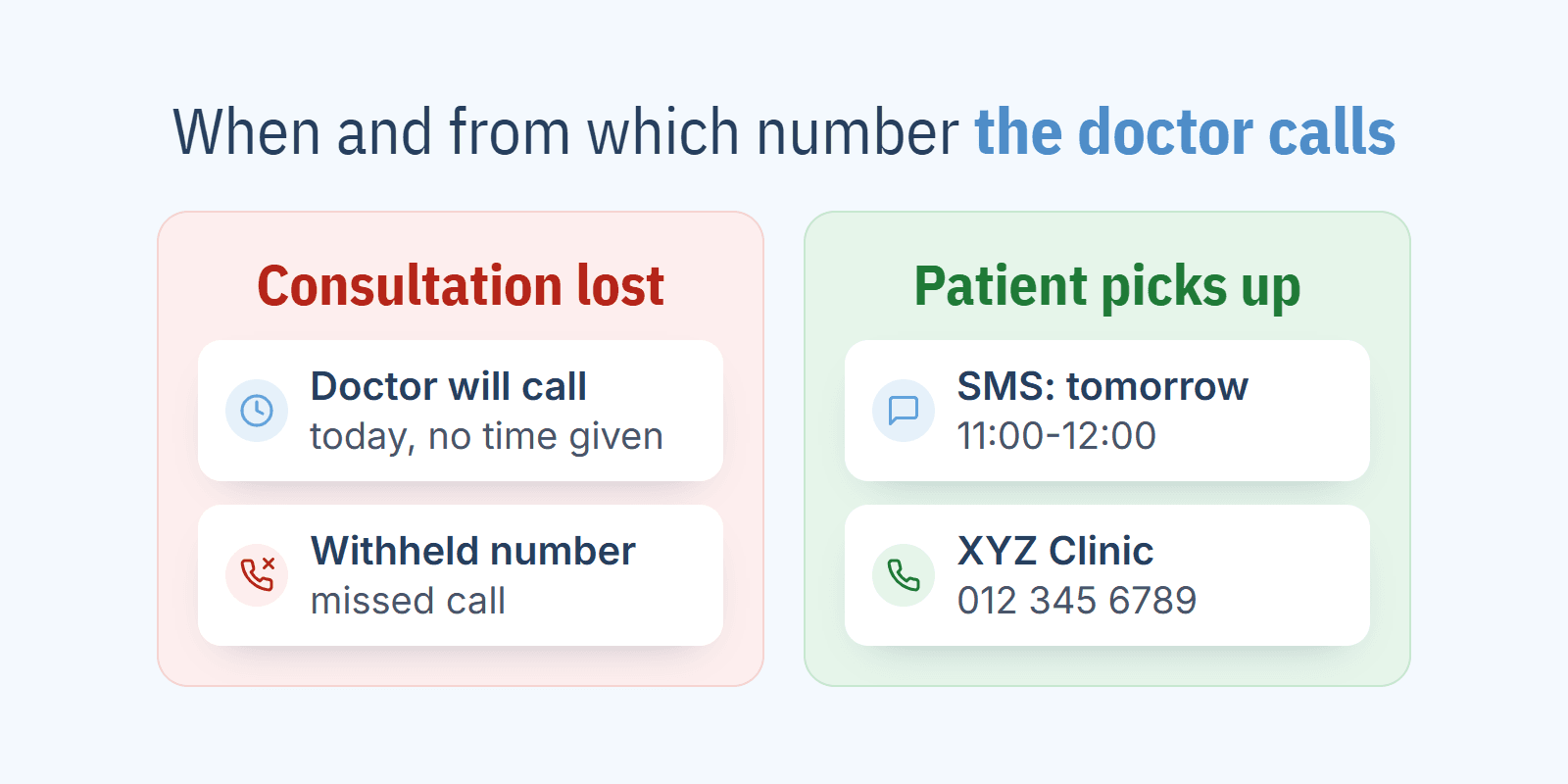
An unanswered call. At peak hours the front desk is busy with patients at the counter, and a new patient who can't get through often calls the next clinic on the list. Calling back missed calls the same day and offering online booking both help.
A website without prices and available appointments. Patients compare prices and dates, so a website where they can't find them sends them to a competitor.
A profile with a low rating. In the same Kraków analysis, private clinics had an average rating of 4.51 (348 profiles), so a clinic rated 3.9 would come off clearly worse than its competitors in Google Maps there.
Before you add more ad budget, check how your rating and number of reviews compare with the clinics around you in Google Maps. If you'd like to talk through how to collect more reviews at your clinic, book a short call with us.
Where should you start on a small budget?
With the channels that need no ad budget, and with measurement. I'd set things up in this order:
- 1.
A complete Google Business Profile for every location, a steady flow of new reviews, and a website with prices and available appointments.
- 2.
The "how did you hear about us?" question at the front desk, and sorting out missed calls.
- 3.
Staying in touch with patients who have already been to the clinic, for example a reminder about a follow-up test, if the patient has agreed to messages like that. The cheapest patient is the one who comes back.
- 4.
One paid channel for the 2-3 services with the highest value, and a comparison of the cost per patient after 2-3 months.
A month-by-month plan for the first 90 days is in my guide to medical practice marketing.
FAQ
How do I get new patients for a private medical practice?
The same way as for a clinic, only on a smaller budget: a Google Business Profile with reviews, booking portals and referrals, with ads only for the 1-2 services with the highest value. A single-doctor practice gains the most from its Google profile and from referrals, because they need no ad budget.
How much does it cost to acquire one patient?
It depends on the channel, the city and the service, so there's no single figure for everyone, but you can work out your own: divide what you spent on a channel in a month by the number of new patients from that channel, and compare the result with how much a patient spends at your clinic in a year.
Can a clinic reward patients for referrals?
It's risky. In Poland, a publicly announced discount or reward for a referral counts as promoting services, and information from a medical facility must not have the features of an advertisement (Article 14 of the Polish Act on Medical Activity). Rules differ by country, so if you're planning a referral program with rewards, check it with a lawyer first.
How do I get patients without ads?
Through your Google Business Profile with reviews, referrals, partnerships with local employers and doctors, and articles on your website. These channels mostly cost your team's time and work more slowly than ads.