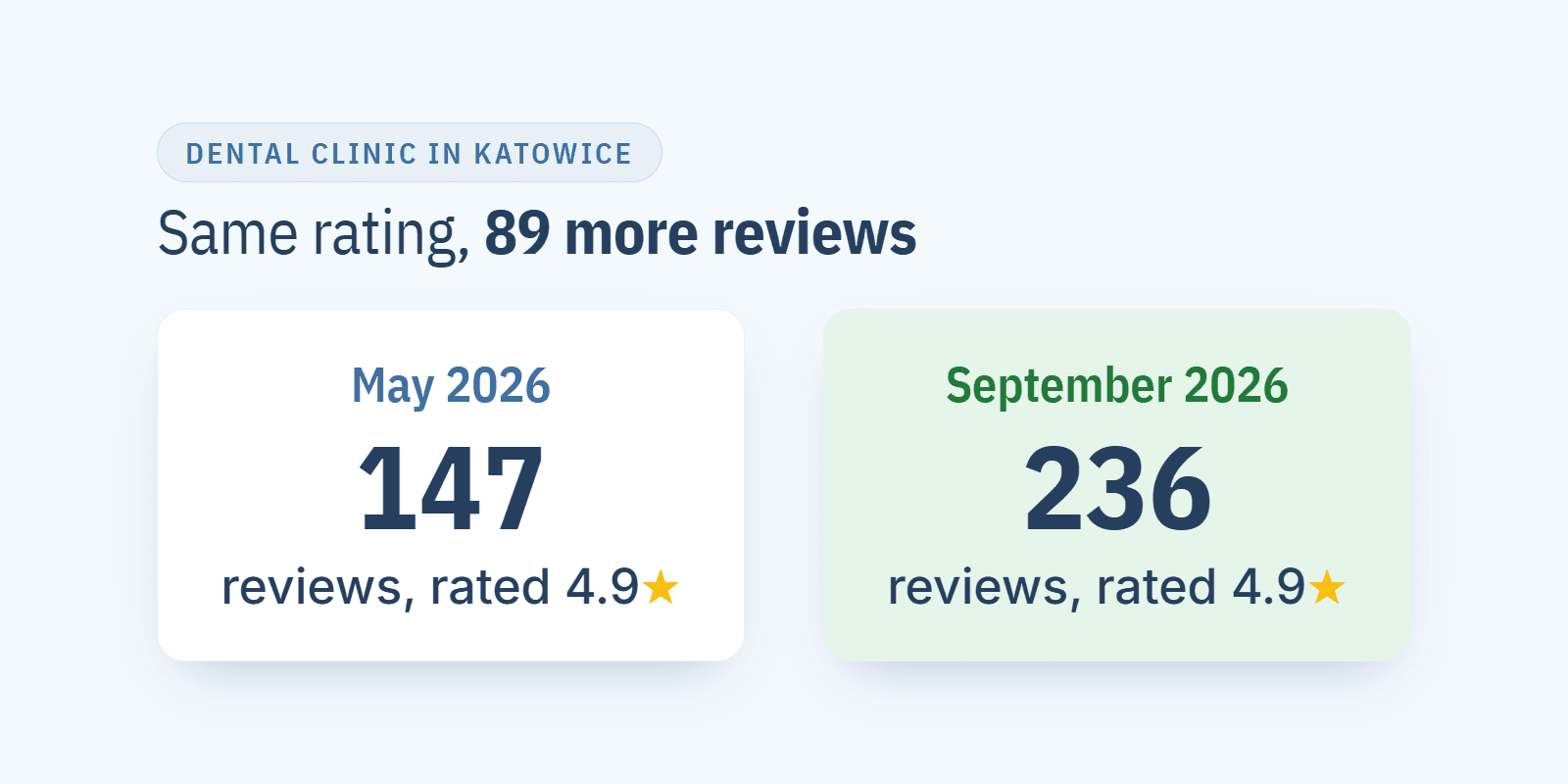
A dental clinic in Katowice, Poland, had a Google rating of 4.9 and 147 reviews. With a rating like that, few clinics think about collecting reviews, because the profile already looks great. This clinic wanted more, and 4 months later, in September 2026, it had 236 reviews with the same 4.9 rating. My guide to Google reviews for medical practices covers how many reviews a practice needs compared with competitors nearby.
About the client
A dental clinic in Katowice, with 700-900 visits a month. Patients rated it highly, but new reviews came in slowly. We started working together in May 2026, when the profile had 147 reviews and a 4.9 rating.
How did the clinic ask for reviews before?
In two ways, and neither brought in many reviews. First the front desk asked patients for reviews, but after a while it stopped. That's hardly surprising: the front desk has phone calls, bookings and payments to handle, and a review request can always wait until tomorrow.
Then the clinic started sending review requests by email. Hardly any new reviews followed. From Repto's data and tests we know that an email review request is 6-10 times less effective than an SMS: some of the messages land in spam, and some patients simply don't read their email.
At the clinic's current SMS pace of about 22 reviews a month, email would bring in 2-4 a month, so few you'd barely notice them. I've compared every way of asking for reviews, with numbers, in my comparison of Google review collection methods.
How has the clinic collected reviews since May?
The day after the visit, Repto sends patients an SMS asking them to rate their visit. A patient who rates the visit highly goes on to Google and adds a review themselves. A patient who rates it lower writes to the clinic first, and the manager gets an email and can call back before the problem reaches Google. The front desk doesn't have to remember anything.
Why an SMS the day after the visit?
Repto's data shows that on average 13.6% of patients click the link in an SMS review request. Timing matters too: a request sent right after the visit arrives at the same time as a booking portal's review request (if the practice uses one), and the patient is then more likely to leave the review there. That's why the SMS goes out the next day.
How many reviews did the clinic gain?
Review count and rating on Google Maps since the start:
May 2026 (start): 147 reviews, 4.9
June 2026: 186 reviews, 4.9
July 2026: 203 reviews, 4.9
August 2026: 210 reviews, 4.9
September 2026: 236 reviews, 4.9
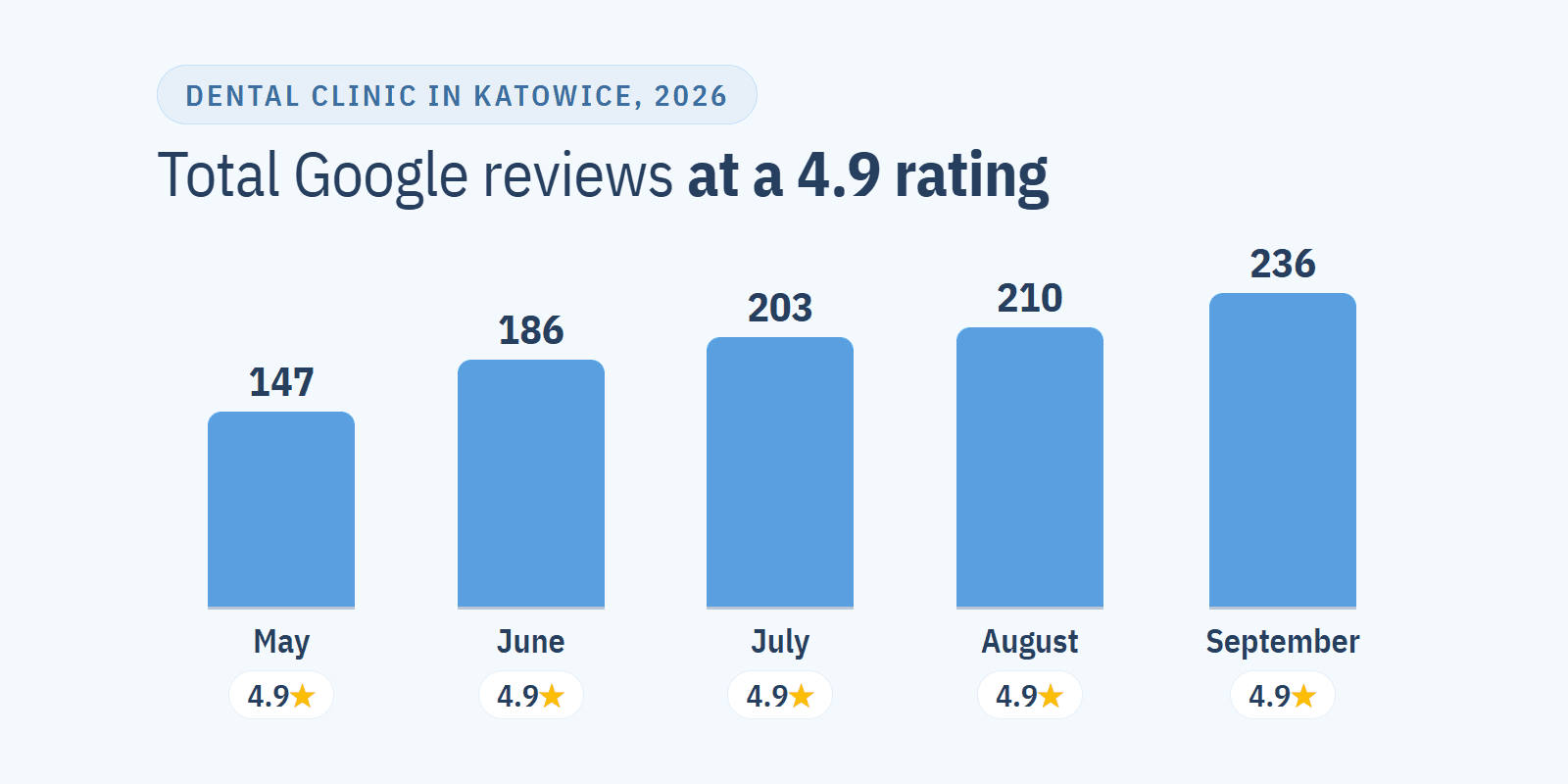
Total Google reviews of a dental clinic in Katowice in 2026 at a 4.9 rating - 147 in May, 186 in June, 203 in July, 210 in August, 236 in September
In 4 months the clinic gained 89 reviews, or about 22 reviews a month, and the rating stayed at 4.9 the whole time. With 61% more reviews, the same rating is now much harder to bring down.
Why collect reviews when you already have 4.9?
Because the rating isn't all a patient sees. When choosing a dentist, they look at two more things: how many reviews there are and how recent they are.
The review count decides whether 4.9 looks believable: to many patients, a clinic with 4.8 and 600 reviews looks more trustworthy than 4.9 with 147. On top of that, review count and rating affect how high a practice appears on Google Maps, as Google states plainly in its help page on local ranking.
Patients also see the dates of reviews, and if the latest one is 2 months old, they start to wonder whether something has changed. With 22 new reviews a month, this clinic's newest review is usually 1-2 days old. My post on dental practice marketing covers where reviews fit next to a practice's website and ads.
How many 1★ reviews does it take to drop from 4.9 to 4.8?
With 147 reviews, 2 one-star reviews are enough, and with 236 reviews it takes 4 (counting from an average of 4.90). Every review carries the same weight in the average, so the more happy patients have already left a review, the less a single bad day counts. The Google rating calculator does the same maths for any other review count.
In dentistry this matters. A difficult procedure or a long wait in the waiting room is enough for a patient to leave angry, and with 147 reviews, 2 such 1★ reviews in one week lower the Google rating straight away. With 236, the same week doesn't change it. And a patient who rates the visit poorly writes to the clinic first, so the manager can call them before that review ever reaches Google.
At 4.9, every 4★ review also lowers the rating, because it's below the average. With 147 reviews, 9 of them are enough to drop the rating to 4.8, while with 236 it takes 14. That's why, with a high rating, collecting reviews works more like insurance than a campaign.
What shouldn't you copy from this clinic?
Email review requests aren't worth switching on as your main method, because they're 6-10 times less effective than SMS and bring in only a few reviews a month. Nor is it worth making the front desk ask every patient, because with phone calls and bookings to handle, that request is the first thing to go. An SMS request sent the day after the visit doesn't depend on anyone's memory, and I show how to word it in my SMS review request templates.
You can see how reviews grew at other practices on our client results page.