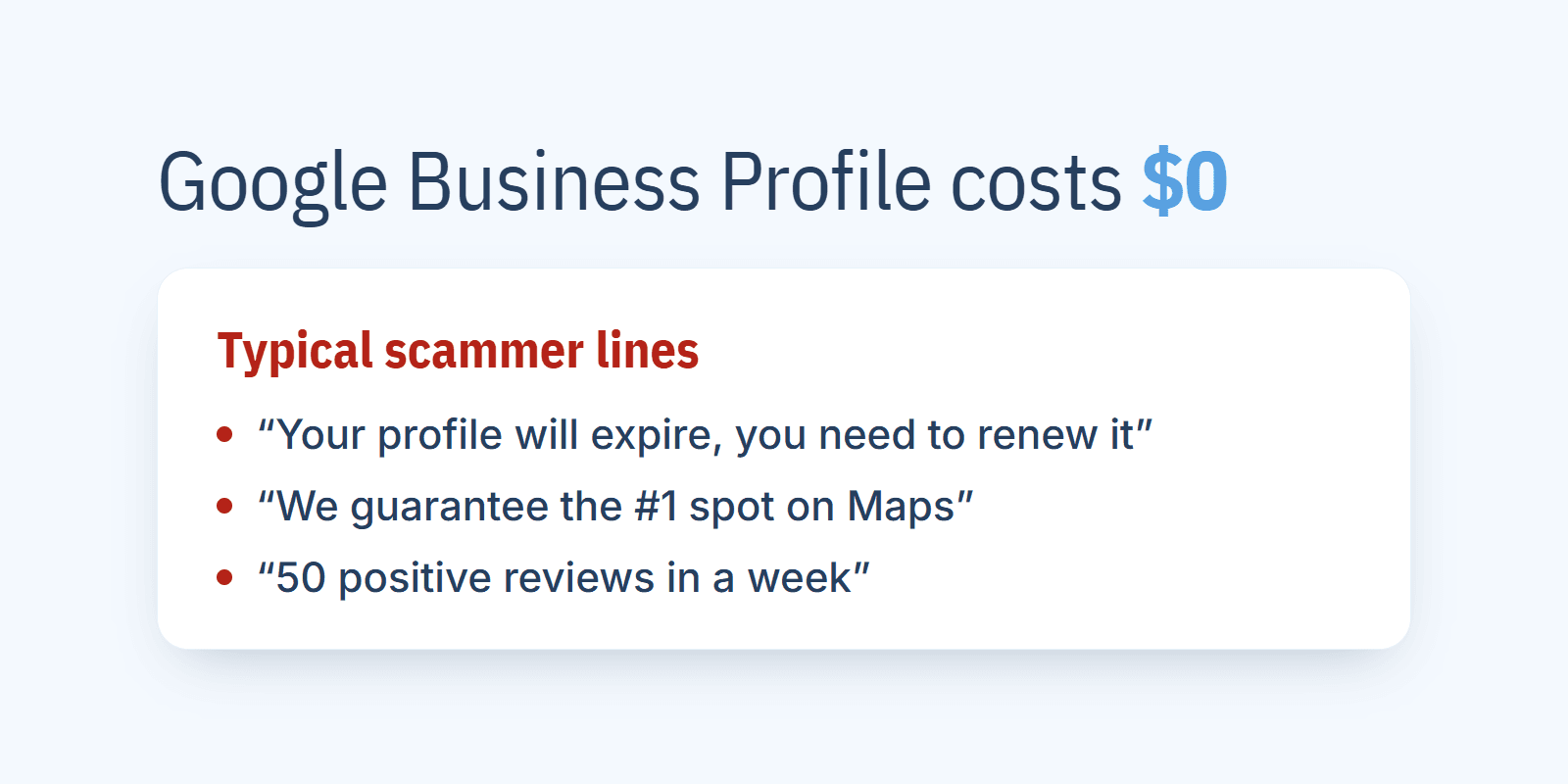
No, Google Business Profile is free. Creating, verifying and running a Business Profile costs nothing, and Google doesn't charge for "maintenance", "renewal" or a higher position in Google Maps. Anyone who calls a clinic "from Google" and wants money is a scammer. A company that pretends to be Google to sell its own service is a scammer in my book too, even if it sends an invoice afterwards.
Car repair shops, restaurants and clinics all get these calls, because each of them has a public number that someone answers. At a clinic that someone is the front desk, which is why there's a ready-made script for them below.
Does Google charge for a Business Profile?
It doesn't. Using a Business Profile is free: you create the profile, get verified, add photos and opening hours and reply to patient reviews at no cost.
There's also nothing to "renew", since it's hard to extend a subscription that never existed. You can't buy a higher position in Google Maps, because Google doesn't sell spots in local results (Business Profile Help). What you can pay for is Google Ads, marked as sponsored, and your profile works fine without them.
How does verification of a new profile work?
A new profile only shows up in Google Maps once the clinic passes verification. Google picks the method, and for a new location it's often one of these two:
Video recording. Google asks for one continuous recording, with no cuts, showing that the clinic really operates at that address: the sign or the street entrance, then the inside, for example the front desk and a consulting room, and something that shows you have access, such as unlocking the door with a key. The clinic waits up to 5 business days for the result.
Postcard with a code. Google mails an ordinary postcard with a code to the clinic's address, and you enter that code in your Business Profile. The postcard takes up to two weeks to arrive, so warn the front desk not to throw it out with the flyers. Don't request a new code in the meantime, because that cancels the one already on its way.
Google sometimes also offers a code by text message or e-mail, or a video call with a Google employee. Every one of these methods is free, and none of them involves anyone "from Google" calling the clinic for money. You enter the code from the postcard, text or e-mail yourself, and you never read it out to anyone over the phone. All the methods are described in Business Profile Help.
Does Google call businesses about their profile?
Sometimes it does, but never for money. An automated call from Google may, for example, confirm your opening hours or other business details in Google Maps (Business Profile Help), and it says straight away who is calling and why.
What matters more is what Google doesn't do on such a call: it doesn't ask for a payment or card details, or for you to sign up for any service. So one simple rule is enough for the front desk: if a caller "from Google" mentions a bank transfer, an invoice, a fee or asks for a code from a text message, the call is over.
What do Google Business Profile scams look like?
Scammers almost always combine urgency, a threat of losing the profile and a small amount that's easy to pay without asking the boss. The most common versions:
"Your profile will expire, you need to renew it." A recorded message or a "consultant" says the profile is about to disappear from Google Maps. In March 2024, police in the Lesser Poland region described a case in which a woman claiming to represent Google told a business owner to "renew" his profile for PLN 512 by bank transfer. He knew the service was free and reported it.
Paid "verification" or "activation". The clinic gets verified inside the Business Profile itself and pays nothing for it. No consultant needs to "speed it up".
"We guarantee the #1 spot in Google Maps." Third-party companies have no direct influence on Google Maps rankings, and you can report a promise like that to Google (form below).
An invoice for "maintaining" the profile that nobody ordered, sometimes with a note that the profile will be deleted unless you pay. You report that to Google too.
Selling reviews. "A package of 50 positive reviews in a week" means fake reviews as far as Google is concerned, and Google can penalize the clinic for them. I describe those penalties in the post on buying Google reviews.
Extortion through negative reviews. A run of one-star reviews suddenly appears on the profile, and then someone writes that they'll disappear if the clinic pays. Google has a separate form for this (below), and you don't reply to the authors and don't pay anything.
Account takeover. The caller asks you to read out the code that "just arrived by text", or to add them as an owner of the profile "to fix it". An owner can remove the other users, so after a "fix" like that the clinic can lose control of its own profile.
Why is a clinic an easy target for scammers?
Because a clinic has everything scammers need: a public number, a front desk that answers the phone all day, and an owner who is a doctor and has five minutes between patients to make a decision. The person at the front desk usually doesn't know whether the boss ordered something from an agency, so just in case, they put the call through to them.
The doctor-owner hears "your profile will disappear at midnight tonight" between two appointments and sends the transfer, because paying a few hundred feels like a smaller problem than losing patients who can't find the clinic in Google Maps. That's exactly what the scammers count on. In clinic chains it's even harder: a marketing team in another city looks after the profiles, while the front desk at every branch picks up the phone.
What should the front desk say? A ready-made script
The front desk doesn't need to recognize scammers: one rule and two sentences are enough. It works best when one person at the clinic (the manager, marketing or the owner) handles everything to do with the profile, and the front desk settles nothing about it over the phone.
- 1.
The caller says they're calling from Google or "about your Business Profile": "Please give me the company name and your number, and the person responsible will call you back."
- 2.
The caller mentions a transfer, an invoice, a fee, the profile "expiring", or asks for a code from a text message: "We don't handle this kind of thing over the phone. Goodbye." And that's the end of the call.
- 3.
A recorded message asks you to press a key: hang up and don't press anything (Business Profile Help).
- 4.
After the call, note the date, the number, the company name and what the caller said, and pass it on to the person who handles the profile.
What the front desk never does: give out codes from text messages, pass on the owner's e-mail address or put the call through to a doctor during an appointment because "it's urgent". If a real agency the clinic works with was calling, the manager will know about it and call back.
How do you check who manages your clinic's profile?
In your Business Profile settings, under "People and access". Sign in to the account that has access to the profile, open the profile, choose the three-dot "More" menu, then "Business Profile settings" and "People and access". You'll see the list of people with access and any invitations waiting to be accepted.
A Business Profile has two roles (Business Profile Help):
Owner has full control: adds and removes users, and can also delete the whole profile. One of the owners is the primary owner.
Manager can do almost everything, but can't manage users and can't delete the profile.
For a medical practice the safest setup is the clinic's own account as the primary owner. A former manager's private inbox, or an agency's from three years ago, works perfectly well right up to the day something needs changing. I'd give an agency the Manager role, because that's all it needs. Google has a useful safeguard here: a newly added owner can't remove other users for 7 days or take over the primary owner role, so you have a week to spot a suspicious invitation.
I'd review this list once a quarter (it takes two minutes) and remove anyone who no longer works at the clinic straight away. While you're there, check that your doctors don't have separate profiles someone once created and abandoned, because patients leave reviews there that nobody replies to.
Where do you report a Google Business Profile scam?
It depends on what happened. A call from a company pretending to be Google goes to Google, a suspicious text or link goes to your national phishing or cybersecurity reporting service, and stolen money goes to the police.
Persistent calls, impersonating Google, ranking guarantees, demands for money to "maintain" the profile: Google's form for reporting third parties that break the Business Profile rules. Google doesn't tell you the outcome, but the report does get reviewed.
A run of negative reviews and a demand for payment to remove them: the extortion report form in Business Profile Help. Keep screenshots of the reviews and all the messages.
A text message with a suspicious link, or a suspicious website or e-mail: forward it unchanged to your country's phishing or scam reporting service, and don't click the link.
The money has already gone, or someone got hold of a code to your account: call your bank straight away, report it to the police and check the list of users on your profile. If someone has taken over the profile, you can get access back through Business Profile Help.
What can you actually pay for on Google?
Advertising, and someone else's work on your profile. Both are legal and completely optional.
Google Ads. Ads in Google Search and Google Maps, marked as sponsored. You pay in your Google Ads account by card or by transfer to the details shown in that account, never to an account number given to you over the phone. Advertising medical services also comes with rules that limit what a clinic can say.
An agency or a freelancer. Running the profile (photos, posts, replies to reviews, keeping categories and services in order) is a normal paid service that a clinic can hand over to an agency or a freelancer.
You can tell an honest agency by a few things: it introduces itself by name, signs a contract with a scope and a price, reports on results, joins the profile as a manager and leaves ownership with the clinic. It doesn't guarantee the #1 spot in Google Maps, because nobody outside Google has any say in that.
I run Repto, which sends patients a text after their visit asking for a Google review. That's a paid service around the profile too, so we're all the stricter about these rules: we contact clinics under our own name and work under a contract. Ask us the same questions, for example on a short call with us.
What actually improves a clinic's visibility in Google Maps?
Free work on the profile itself. Local ranking depends on three factors: relevance (how well the profile matches the search), distance from the person searching and prominence (how well known the business is). You can't change distance, but the other two are largely up to the clinic.
Relevance: the right primary category and additional categories for the specialties you really offer, current opening hours, a list of services, a website, a phone number someone answers, and photos: the entrance, the waiting room, the consulting rooms, the parking area. A patient coming for their first ultrasound wants to know which door to use. If the clinic added photos from before the renovation, or of doctors who no longer see patients, you can remove them yourself, as I show in the guide on how to remove a photo from your Google Business Profile.
Reviews: they're part of prominence, and the more reviews and the better the ratings, the better the chance of a higher position (Business Profile Help).
You set photos and categories up once, while your review count grows every week if someone asks patients for reviews regularly. How to do that all year round is in my guide to Google reviews for medical practices.
FAQ
How much does it cost to set up a Google Business Profile?
Nothing. Creating, verifying and running a Business Profile is free. You only pay if you choose to hire an agency to run the profile or buy ads in Google Ads.
How do you verify a Google Business Profile?
Inside the Business Profile itself, for free, using the method Google picks: for a new location it's often a video recording or a postcard with a code (both described above). You enter the verification code yourself and never give it to anyone who calls asking for it.
Can my Google Business Profile expire if I don't pay?
No, because there's no fee to renew. Google can suspend a profile for breaking its rules, but you then see a notice in your Business Profile dashboard. Nobody from Google calls about it asking for a payment.
Does Google call businesses?
Sometimes, yes, with an automated call to confirm your details in Google Maps. The automated call says straight away that it's Google, and it never asks for a payment or card details, or for you to sign up for a service. No honest caller will ask for a code from a text message over the phone either.
What should we do if we've already paid?
Call your bank, report it to the police and keep the evidence: the number, the date, the transfer confirmation, the messages. Then check who has access to your profile and report the company through Google's form.
Can an agency guarantee the #1 spot in Google Maps?
No. Third-party companies have no direct influence on rankings in local results, and you can report a promise of top positions to Google through the third-party form.