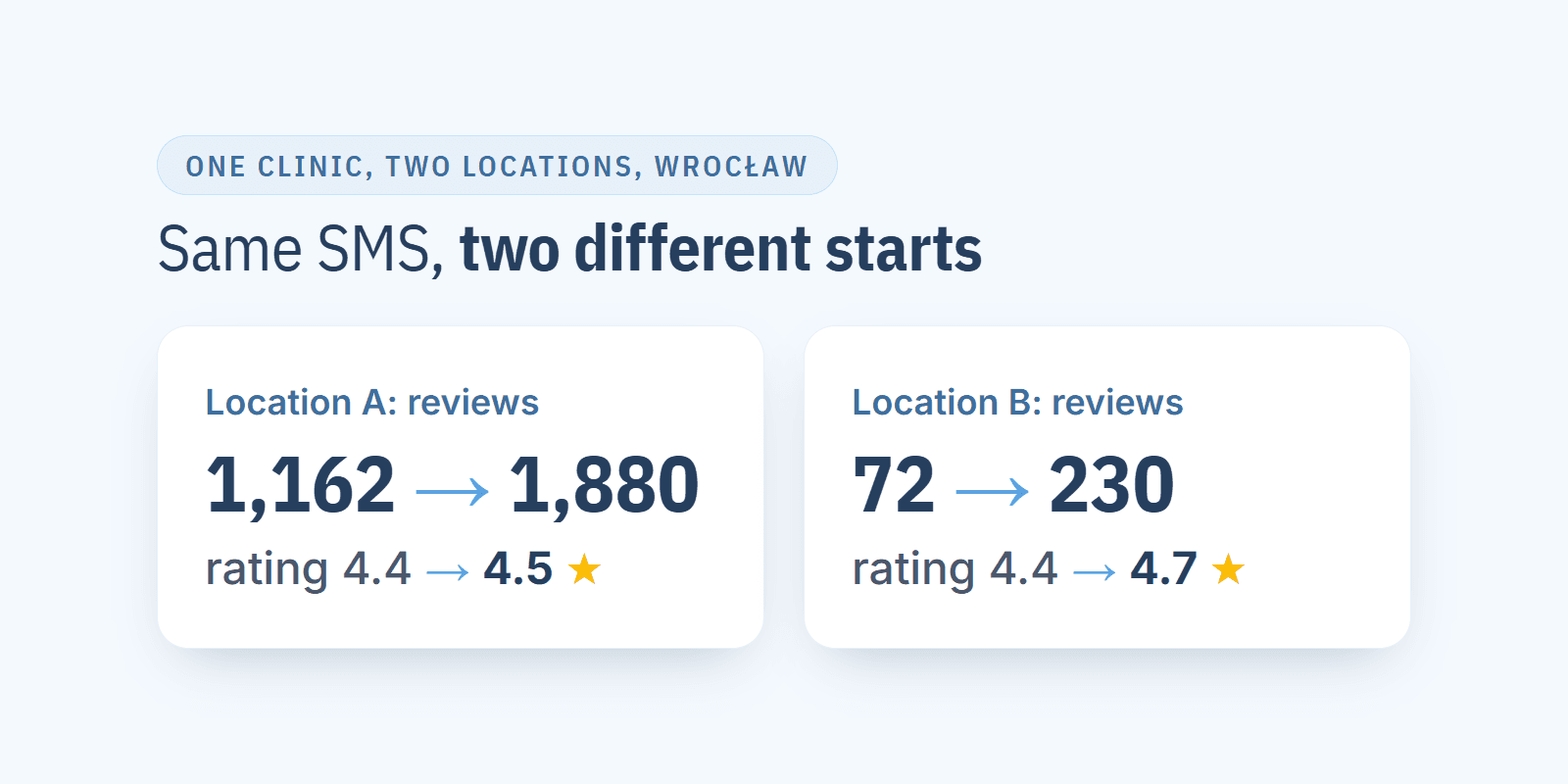
Same clinic, same review request SMS, two Google Business Profiles. The first started with 1,162 reviews, the second with 72. By September 2026 the large one had gained 718 new reviews, and its rating rose from 4.4 to 4.5. The small one more than tripled its review count, to 230, and reached a 4.7 rating. I explain how Google calculates the rating in my guide to Google reviews for medical practices.
About the client
It's a multispecialty clinic in Wrocław, Poland, with two locations and a focus on gynecology and obstetrics. The main location handles 1,500-2,500 visits a month, the second 400-600. Visits reach Repto automatically through an integration with the clinic's software. At the main location (Location A from here on), the first SMS requests went out in January 2026. The second, smaller one (Location B) started with Repto in February.
What did the two locations start with?
Location A: 1,162 reviews, a 4.4 rating (4.39 to be exact). A large, mature profile, but with almost no new reviews before Repto. For a location that sees patients every day, the profile looked more like an archive.
Location B: 72 reviews, a 4.4 rating.
The starting rating was the same. What differed was the weight of a single review: with 72 reviews, each new review moves the average 16 times more than with 1,162.
Location A: lots of reviews, the rating rises slowly
In February, the first full month, the profile gained 111 reviews, 110 of them from Repto's SMS requests. The average went from 4.39 to 4.43. The profile showed 4.5 for the first time in March, at 1,387 reviews, and kept that rating through September 2026, when it had 1,880 reviews. It gained between 63 and 111 reviews a month.
On a profile this size, the next 0.1 is a long way off. If the exact average is 4.50, the profile needs more than 200 further 5★ reviews without a single lower one before it shows 4.6. Every 4★ review pushes that moment further away, because with an average of 4.5, even a 4★ review lowers it. My Google rating calculator shows how to work this out for your own profile.
On a profile like this, a steady stream of new reviews pays off in other ways than the rating:
Freshness. The latest reviews a patient sees are from the last few days.
Stability. With 1,880 reviews, one 1★ review lowers the average by 0.002. Even ten 1★ reviews would lower it by less than 0.02.
A lead over the competition. Competitors nearby won't catch up with a profile of almost 2,000 reviews any time soon, even if they start collecting reviews themselves.
Location B: few reviews, the rating changes fast
In February the profile gained 24 reviews (from 72 to 96), 18 of them from Repto's SMS requests. The rating went up every few weeks: 4.5 in February, 4.6 in March, 4.7 in April, at 127 reviews. The 4.7 held through September 2026, when the profile had 230 reviews, more than 3 times as many as at the start, so that rating is now harder to pull down. It gained between 8 and 30 reviews a month.
With 72 reviews, one 1★ review lowers the average by almost 0.05, but for the same reason a few dozen new 5★ reviews lift it quickly. That's why a small profile gains the most at the start: Location B needed 55 new reviews to go from 4.4 to 4.7.
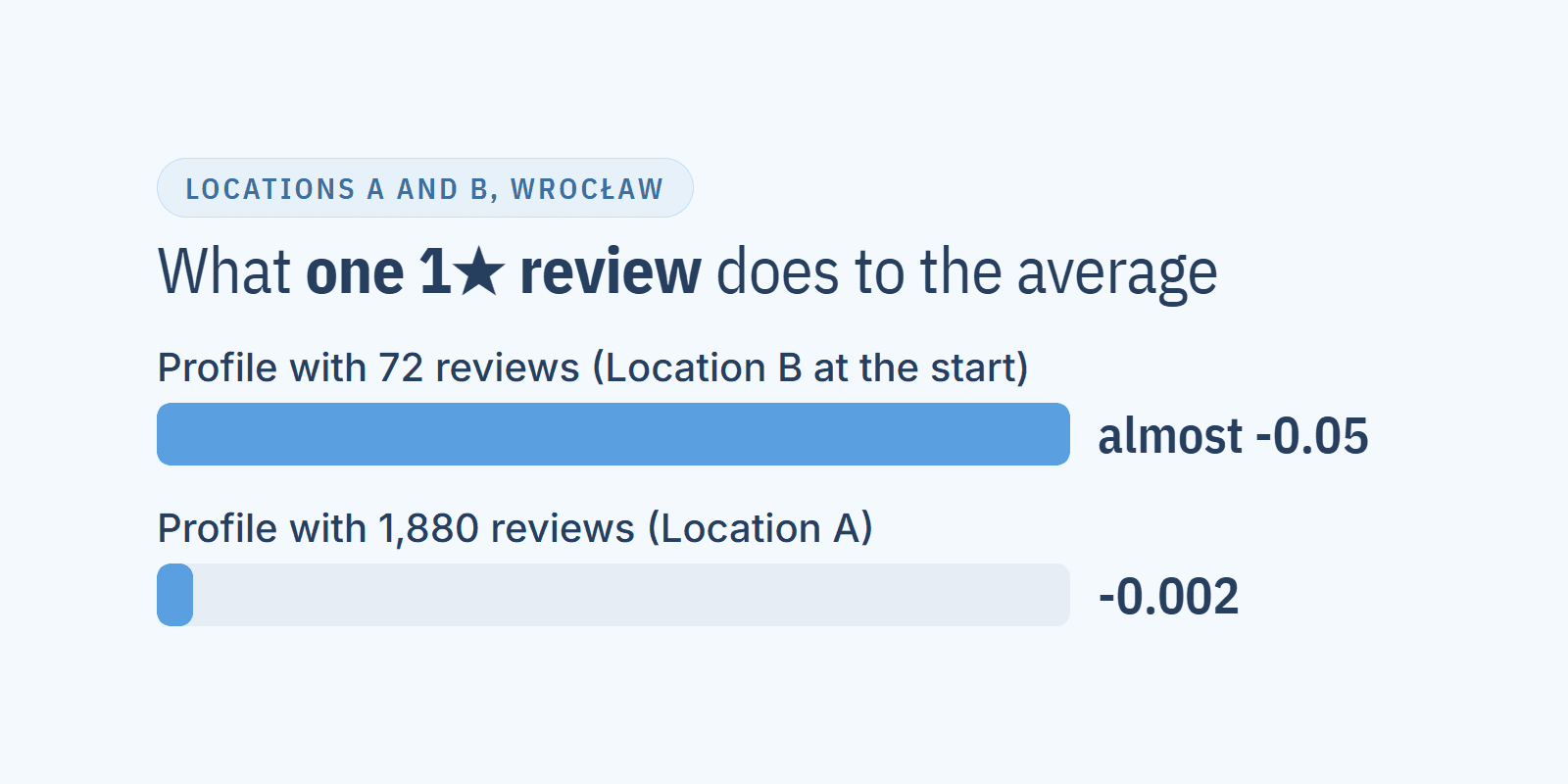
Bar chart: one 1-star review lowers the average by almost 0.05 on a profile with 72 reviews (Location B at the start) and by 0.002 on a profile with 1,880 reviews (Location A)
What was the same at both locations?
The same sending time: the SMS goes out the day after the visit.
The same SMS wording, written together with the clinic at the start.
A separate link for each profile. The patient gets a review request for the location they actually visited, so reviews don't get mixed up between profiles.
What differed was the number of visits (several times higher at Location A) and the starting review count. The number of visits determines how many reviews come in each month, and the starting review count determines how fast the rating changes.
What does this mean for your clinic?
If a location has more than 1,000 reviews, there's no point waiting for the rating to jump. It makes more sense to track the number of new reviews a month, because they keep the profile looking current, and a few weaker weeks will barely move the average.
If it has fewer than 100 reviews, the rating moves quickly in both directions. Every negative review stands out more there, so it's worth calmly replying to each one.
Repto sends the patient an SMS asking them to rate the visit. A happy patient goes straight to the Google review form, and an unhappy one writes to the clinic first: the manager gets an email and can call the patient back. I compare this with other ways of collecting reviews in my post on automated Google review collection.
FAQ
Is it worth collecting reviews if a location already has more than 1,000?
Yes, even though the rating moves slowly. Over 8 months, Location A gained 63-111 reviews a month: the profile stays fresh, and the odd weaker review barely changes the average.
How do you collect Google reviews for several locations of one clinic?
Each location needs its own link to its own profile, and the request should name the location the patient visited. That way each profile grows on its own, and one dashboard shows which location is collecting fewer reviews.
How long does it take to raise the rating of a small profile?
For Location B, going from 4.4 to 4.7 took about 3 months and 55 new reviews.
Results for other clients are on the Repto results page.