Patient communication at a clinic is everything a patient hears and reads from the first phone call to the message after the visit. The doctor is responsible for the conversation in the consulting room, and the practice manager runs everything else: reception, the waiting room, the price list and contact about results. Those are exactly the stages that a large share of negative Google reviews are about.
Guides to doctor-patient communication stop at the consulting room door, yet patients often make up their minds about a clinic at the front desk, or after a phone call nobody picked up.
Which communication mistakes end in a negative Google review?
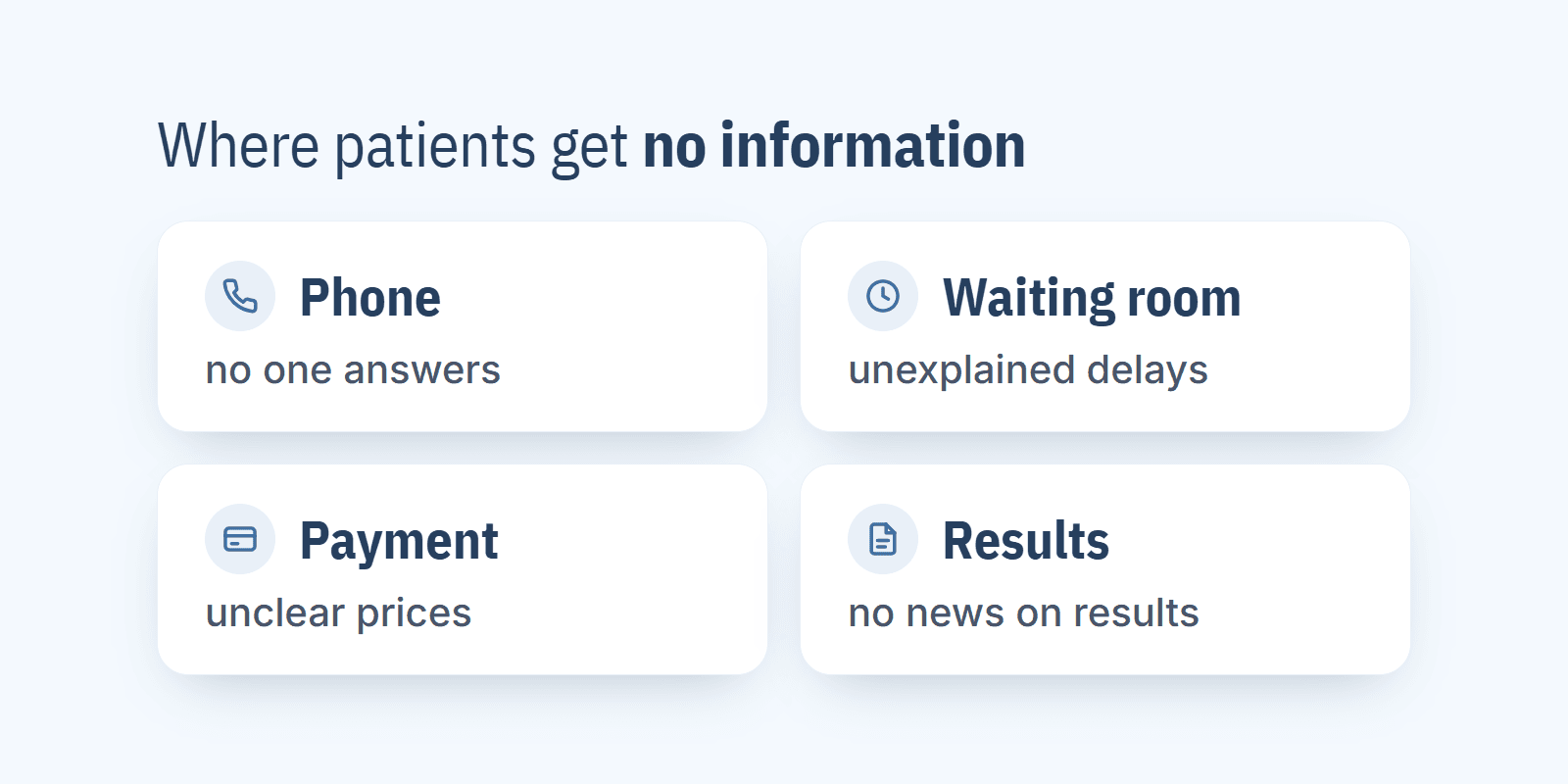
Usually the ones that leave the patient without information, or feeling that nobody took care of them: a wait nobody explained, a price higher than expected, an unfriendly tone at reception and silence about results. These topics come up again and again in reviews of clinics in every specialty.
Waiting without a word of explanation. The patient waits 40 minutes and nobody tells them how much longer it will be. Patients usually forgive the delay itself, the silence around it less often, and in the waiting room they have plenty of time and a phone in their hand.
Unclear prices. The consultation cost what the price list said, but then came the anesthetic, an extra measurement or the report on a scan. The patient only found out about the extra charge when paying at reception, and that's what they'll describe in the review.
Tone and unanswered calls. "There are no appointments" with no alternative offered. A phone nobody answers because reception is busy with the queue at the desk sends the patient a message too. A very clear one.
No contact about results. The patient doesn't know when the results will be ready or whom to call with a question.
A rushed consultation. The doctor was competent, but the patient left without clear instructions and with the feeling they'd been a nuisance.
None of these points is about the quality of treatment, which is why I consider them the cheapest to fix: all it takes is a procedure and a few lines the staff have ready in advance.
Unhappy doesn't have to mean 1★, either. A patient who was happy with the doctor but waited with no information may leave 4★, and when the average is high, a rating like that pulls it down too.
Once a negative review is up, the best move is usually to get in touch with the patient: a few times I've seen a practice manager contact the patient, the matter got cleared up, and the patient deleted the review themselves.
What are the rules of good patient communication?
Good patient communication means the patient always knows what's happening, what it costs and what to do next. At a clinic, that comes down to 7 rules:
- 1.
Tell patients before they ask. A delay, an extra charge or the wait for a result mentioned up front sounds like care; mentioned only when the patient asks, it sounds like an excuse.
- 2.
Be specific. "About 20 minutes" instead of "just a moment". "Results in the patient portal on Thursday" instead of "sometime this week".
- 3.
Always offer a next step. If there's no appointment available, offer the waiting list, another day or another doctor.
- 4.
One version of the information. The price list, the wait for results and the cancellation policy should be the same on the website, at reception and with the doctor.
- 5.
Show understanding first, explain second. After "I understand this is frustrating", the patient starts listening, but they tune out when you read the policy out loud.
- 6.
Protect medical data. No health information over the phone without confirming the caller's identity, and no test names said out loud in the waiting room.
- 7.
Ask after the visit how it went. It's the only way to hear about a problem before you read about it online.
How do you communicate with patients at each stage of the visit?
The practice manager can split the visit into 4 stages and decide for each one who says what, and when.
Phone and online booking
The first contact is usually a phone call or a booking form. Here the patient judges two things: whether anyone answered, and whether they got a clear answer.
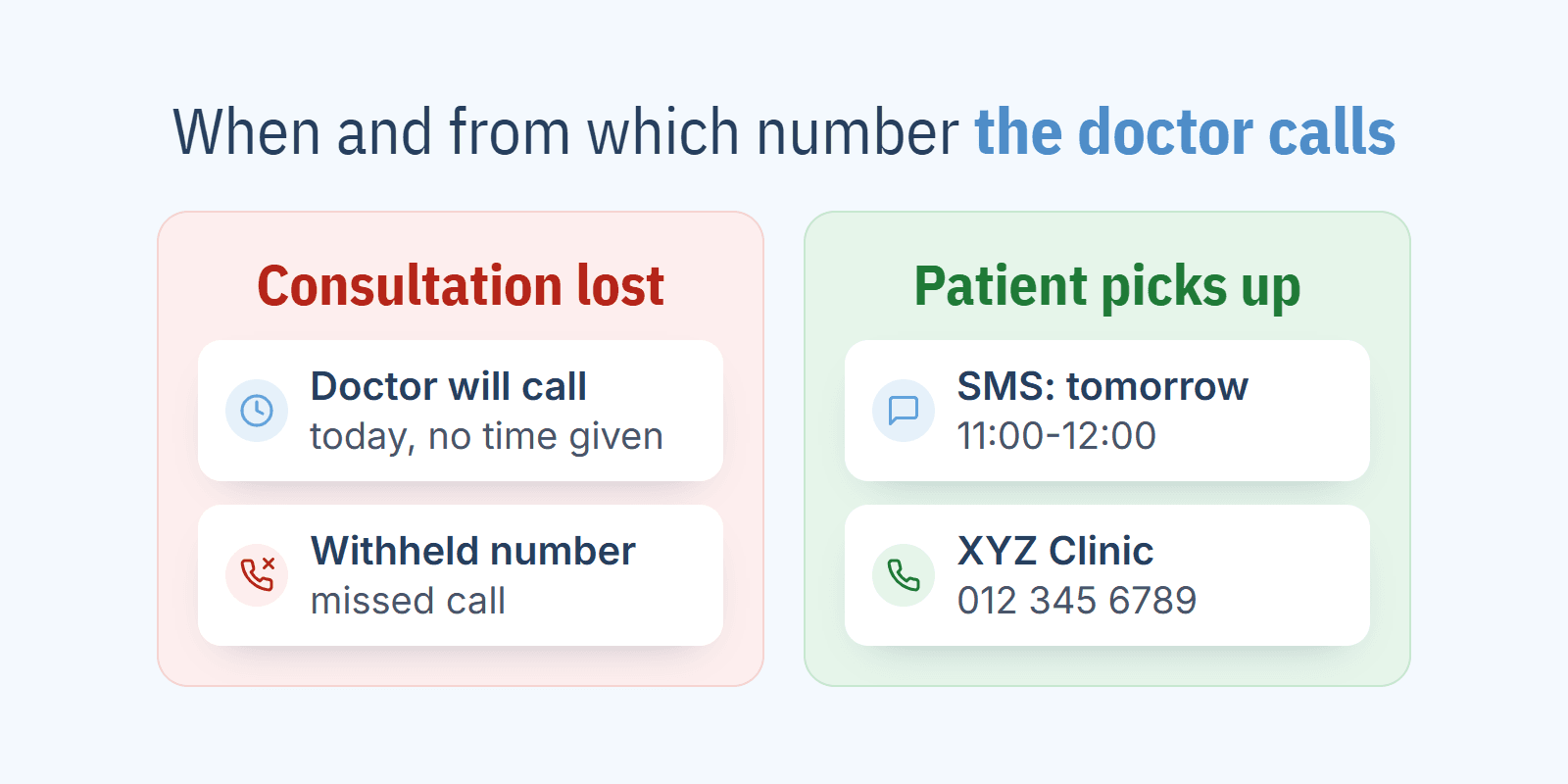
When the patient books, reception can pass on straight away what the patient will ask about later anyway: the price of the visit or its range, how long it takes, how to prepare (fasting, previous test results, a list of medications) and the cancellation policy. When that information is also in the SMS or e-mail confirmation, fewer people call reception, and the patient doesn't find out only in the consulting room that they were supposed to come in fasting. For a phone consultation, add the time window and the number the doctor will call from, which I cover in the post about phone and video consultations at a clinic.
Waiting room and waiting times
Delays at a medical practice are normal, because one difficult case pushes back the whole schedule. Reception has little say over the schedule, but it decides whether the patient knows how much longer they'll wait.
A simple rule does the job: when a doctor runs more than 15 minutes late, reception tells the patients waiting for that doctor and gives an estimated time. It also offers a new appointment, or the option to go for a coffee and get a call when it's the patient's turn. With a longer delay, reception can also give patients booked later in the day a heads-up by text. A TV showing a news channel in the waiting room doesn't count as information about the delay.
Consulting room: explanation, consent and costs before treatment
In the consulting room, communication belongs to the doctor, but the clinic can make it easier. Before a procedure, the patient should know what the doctor will do, why, and what it costs, especially in dentistry and aesthetic medicine, where the treatment plan can change along the way.
When the patient gets a written cost estimate before treatment starts, along with information about possible extra charges, a dispute over the price usually never starts. Reception can hand the patient the consent form to read in the waiting room, so the patient walks into the consulting room with their questions ready.
After the visit: instructions, results and contact
After leaving the consulting room, patients forget a good part of what they heard. That's why written instructions (a printout, the patient portal, an e-mail) are the simplest communication improvement a clinic can make.
On the way out, reception tells the patient 3 more things: when the results will be ready, where to find them and which number to call if something isn't clear. A patient without that number waits for the clinic to get in touch, and then writes a review along the lines of "nobody ever got back to me".
What should reception say? Example lines
The lines below are templates: the receptionist can say them in their own words, without reading from a card. I explain how to organize the front desk itself in the guide to front desk patient service.
When the doctor is running late
"Anna, the doctor is running about 25 minutes late today because the previous appointment took longer. I can offer you another time, or call you when it's your turn."
"I'm sorry you've had to wait. You're next, and the doctor will see you in about 10 minutes."
When a patient asks about the price
"A consultation is [price]. If the doctor suggests an extra test, they'll tell you the price first and check you're happy to go ahead."
"The doctor will give you the exact cost of treatment after the examination, in a written estimate. It's usually between [X] and [Y]."
Fill in your own prices. What matters is that reception has the current price list with extra charges at hand. A price list only the accounts team knows won't help the receptionist at the desk.
How do you handle a difficult patient at the front desk?
A difficult patient is most often someone stressed by a diagnosis or tired of waiting. A simple order helps the receptionist: listen, name the problem, offer a next step.
"I understand you've been waiting for an hour and that's frustrating. I'll check how much longer it'll be and get back to you in two minutes."
"I can't change that on the spot, but I'll pass it on to the practice manager, who will call you today by 4 pm. Is this number still the best one to reach you?"
Reception also needs a clear rule: when it hands a matter over to the manager and who calls the patient back. Without that rule, the receptionist is left alone with the hardest conversation of the day, and the patient with the feeling that nobody made a decision.
When a patient asks about results over the phone
"You'll find your results in the patient portal. Over the phone I can only give them to you once I've confirmed your identity, and if you'd like to go through them, I'll book a short call with the doctor."
Information about a patient's health is confidential and may be shared with the patient or a person the patient has authorized. So reception doesn't give results or visit details over the phone until it has confirmed the caller's identity under the clinic's procedure, and gives them to a family member only if the patient has authorized that person. The clinic sets the details of the procedure with its data protection officer (DPO).
Why is the message after the visit part of patient communication too?
Because it's the moment the clinic asks the patient how it went, before the patient writes about it on their own. Reception has no time to call every patient after the visit, so the simplest way to ask is by SMS.
A well-written post-visit message has 3 features. The patient gets it the next day, between 10 am and 12 noon or between 6 and 7 pm, because a message sent right after the visit collides with the review request from the patient's booking platform.
The message is short, with the patient's first name and the clinic's name, and no test name or specialty, because someone else at home may read the SMS. And a patient who wasn't happy with something can write to the clinic straight from it, so the manager has a chance to call back and sort it out.
The patients' answers also tell you which stage (phone, waiting room, price list) to fix first.
Repto, which I run, sends these SMS messages automatically: the day after the visit, the patient gets a request to rate it, and anyone who rates the visit low writes to the clinic first, while the manager gets an e-mail straight away. You'll find review request texts that work for our clients in the review request SMS templates.
How do you train staff and set communication standards?
What helps is a short, written standard and regular training on real examples from your own clinic. A few weeks after a one-off "customer service" training session, all that's left is a certificate in a drawer.
A written communication standard can fit on two pages:
the greeting on the phone and at the desk (the clinic's name, the person's first name),
answers to patients' 10 most common questions, with the current price list and extra charges,
the procedure when a doctor runs late (after how many minutes, who tells patients, what they offer),
the procedure for passing on results and discussing health over the phone (identity, authorizations),
escalation rules: when a matter goes to the manager and how soon the manager calls the patient back,
who replies to Google reviews (someone with owner or manager access to the Google Business Profile) and how quickly.
A new person at reception gets the standard on their first day, before they hear their first complaint.
The material for training is patient reviews. Once a month, pick 3-4 reviews from the last few weeks, positive and negative, and go through them with the team: how the patient saw the visit and what someone could have said differently. Patients' and staff members' names stay out of the room.
There's one thing I wouldn't add to the standard: an obligation to ask every patient for a review. Owners often want it, but I've seen up close that reception either has no time for it or stops after a few weeks, so I'd move the review request to the message after the visit.
How do you measure the quality of patient communication?
The quality of communication shows in 3 places: in complaints, in post-visit ratings and in the topics of negative reviews.
Complaints and feedback. Keep a simple complaints log: date, stage of the visit (phone, waiting room, consulting room, results), topic, who called back and when. After 3 months you'll see which stage causes the most problems.
Post-visit ratings. Far more patients answer a short rating by SMS or in a survey than write a Google review on their own initiative. NPS needs a separate question about recommending the clinic on a 0-10 scale, and I show how to ask it and calculate the score in the guide to NPS in healthcare.
Topics of Google reviews. Once a month, assign every new 1-4★ review to a topic: waiting, prices, reception, results, doctor, other. If "waiting" comes up less often after you've introduced the delay procedure, the procedure works.
FAQ
What are the communication styles, and which one works at reception?
Communication guides list 4: passive, aggressive, passive-aggressive and assertive. At reception, the assertive style works: calm, polite and specific, with clear information about what the clinic can and can't do. The passive style ends in promises reception won't keep, and the aggressive one in a 1★ review.
Can reception give a test result over the phone?
Only to the patient or a person the patient has authorized, and only after confirming identity under the clinic's procedure. It's simpler when reception points the patient to the portal or books a call with the doctor. The clinic sets the procedure with its data protection officer.
How should you tell patients the doctor is running late?
Straight away, once the delay passes 15 minutes, with an estimated time and an option: a new appointment, or a call when it's the patient's turn. With a longer delay, an SMS to patients booked later in the day lets them come in later instead of waiting in the waiting room.
Does patient communication affect Google reviews?
Yes, because a large share of negative reviews of medical practices are about waiting, prices, the tone at reception and contact about results. Good communication on its own won't raise the average, though. What I hear most often from clinics is that angry patients remember to leave a review and happy ones forget, so without a review request, it's mostly the former who write on Google. What raises the average is a review request sent after every visit: that's how a gynecology clinic in Poland went from a 3.4 to a 4.4 rating.
Who at a clinic is responsible for patient communication?
In the consulting room, the doctor; at every other stage, the practice manager. The manager sets the standard, keeps the price list and procedures up to date, and calls back patients who have reported a problem.
If you'd like to see how a message after every visit would work at your clinic, book a short call with us.