A smear campaign (in some countries it goes by "black PR") is a deliberate attempt to damage someone's reputation with false or twisted information, usually in a way that hides who is behind it. For a medical practice it tends to look fairly mundane: a string of 1-star Google reviews from people who have never been patients. Google can remove reviews like these, but the clinic has to notice them and report them first.
I run Repto, a company that helps clinics collect reviews from real patients, and clinics that have just received several negative reviews in a short time often book a call with me. With a series like that it's easy to assume a competitor is behind it, so below I show how to check that and what to do in either case. How reviews work in a clinic day to day is covered in my guide to Google reviews for medical practices.
What is a smear campaign?
It's any effort meant to damage the image of another business or person: rumors, half-truths, fake accounts, made-up stories and fake reviews. The name "black PR" flips public relations, the work of building good relationships with the public, but the two share nothing beyond the name: this is plain disinformation whose author stays hidden.
People tend to associate smear campaigns with elections and fights between large companies, but online all it takes is a phone and a few Google accounts, so any clinic with a profile on Google Maps can become a target.
What does a smear campaign against a clinic look like?
Most often, a sudden wave of negative reviews. The examples below are made up, but they follow the usual patterns:
Five 1-star reviews in one night, from accounts with no photo and no other reviews, on a profile that until then got one review every few weeks.
Reviews about a doctor you don't employ or a treatment you don't offer, written in strong language ("botched job", "rip-off").
A post in a local Facebook group saying "beware of clinic X", from an account with no friends and no other posts.
The same reviews on several sites at once, for example on Google and on a doctor review site, in similar words and in the same week.
It also works the other way round: a business adds 5-star reviews for itself. Google's rules ban that just as firmly as an attack, and what a clinic risks by doing it is covered in my article on buying Google reviews.
How do you tell an attack from ordinary patient criticism?
By the number of reviews, the timing and the reviewers' accounts. At Repto we analyzed 653 public Google Business Profiles of medical practices in Kraków, Poland (data as of 20 October 2026). The typical profile there gets about 1 new review a month, while among its 10 most recent reviews an average of 20% are 1-2★ ratings. One bad review is normal. Five in two days on a profile that is usually quiet is not.
Signs that, taken together, point to an attack:
- 1.
Timing. Several reviews within hours or a single day, often outside the clinic's opening hours.
- 2.
Accounts. New, no photo, one or two reviews in total, sometimes with reviews of businesses in another city. Sometimes the same account has recently given 5★ to a clinic down the street.
- 3.
Content. Generic complaints with no details of the visit, similar phrases across several reviews, or details that don't match (the doctor, the service, the location).
- 4.
Your records. The practice manager checks in the clinic software whether someone with that name had a visit at that time. The result stays inside the clinic, because data from your records can't go into a public reply.
If the reviews describe real visits, even unfairly, that's a sign something went wrong with the service. Then what helps is a calm reply to the negative review and fixing whatever went wrong. Reporting reviews like that to Google usually gets rejected.
Does Google remove fake reviews from competitors?
Yes, if they break the rules and the clinic reports them. Google's Maps user contributed content policy explicitly bans posting content about a competitor's business to undermine its reputation. Attacks on clinics usually fall into four categories:
Fake engagement: reviews from several accounts run by one person or posted at someone's request, including reviews written to hurt a competitor.
Conflict of interest: a review from a competitor in the same field or from a former employee.
Rating manipulation: an unusual volume or pattern of reviews, which is exactly what an overnight series of 1-star reviews looks like.
Off-topic content and harassment: reviews written to harass someone, with no visit described at all.
When Google detects suspicious activity around a business's reviews, it can remove them, temporarily block new reviews and show a banner on the profile saying suspicious reviews were removed (consumer alerts). Profile restrictions for fake reviews (with an email to the owner) mainly hit businesses that order those reviews themselves, so a clinic that is under attack shouldn't worry about that (Business Profile restrictions).
Google can't see your clinic software. It judges accounts and posting patterns, so a well-written fake review from a "normal" account can stay up. A series from empty accounts has a much better chance of being removed.
What should you do when your clinic is the target of a smear campaign?
Collect evidence first, then report, and only think about a lawyer at the end. In this order:
- 1.
Screenshots of every review with the date, the text, the reviewer's name and their profile (number of reviews, other businesses they rated). If Google removes a review or the author deletes their account, the evidence goes with it.
- 2.
Report each review separately in the Reviews Management Tool for your Business Profile, choosing fake engagement or conflict of interest as the reason. The step-by-step process is in my guide on how to remove a Google review.
- 3.
Report from the public profile as well. In a few cases I've seen reports from the public profile work better than a report from the dashboard, when several people each reported from their own account. This only makes sense for reviews that really do break the rules.
- 4.
The same short, neutral reply under every suspicious review: thank the reviewer, don't go into any details of visits, and give the practice manager's contact details. You'll find a ready-made template among the replies to negative reviews.
- 5.
An appeal if Google rejects your report. You get one appeal against the decision, and you can select up to 10 reviews in it (Google Business Profile Help), so describe everything you've collected: the timing of the series, the empty accounts, the link to a competing clinic.
If a competitor is behind the attack and is spreading false information about your clinic, it can become a legal matter. In Poland, for example, that may count as an act of unfair competition, and serious accusations may also be defamation. The rules differ from country to country, so whether a claim makes sense is a question for a local lawyer. And if the matter spreads beyond reviews, say to the local press, you'll need a plan for a reputation crisis at your clinic.
What not to do when a competitor attacks you with reviews
Don't hit back the same way. When you're angry, each of these moves feels fair, but later it hurts your clinic more than the attack itself:
1-star reviews on the competitor's profile. It's exactly the same practice, just on your side now, and it breaks the same Google rules.
Asking staff and family for 5-star reviews "to even things out". Reviews from employees are a conflict of interest, and a run of 5s right after a run of 1s looks to Google like more manipulation.
A company that will "remove all your bad reviews". It has the same reporting options you do, it just sends you an invoice for them, so a promise to remove every review is, to me, plain fraud.
Publicly accusing the competitor by name in a reply to a review or on Facebook. Without proof, the clinic exposes itself to a defamation claim.
How do you make your Google profile resistant to fake reviews?
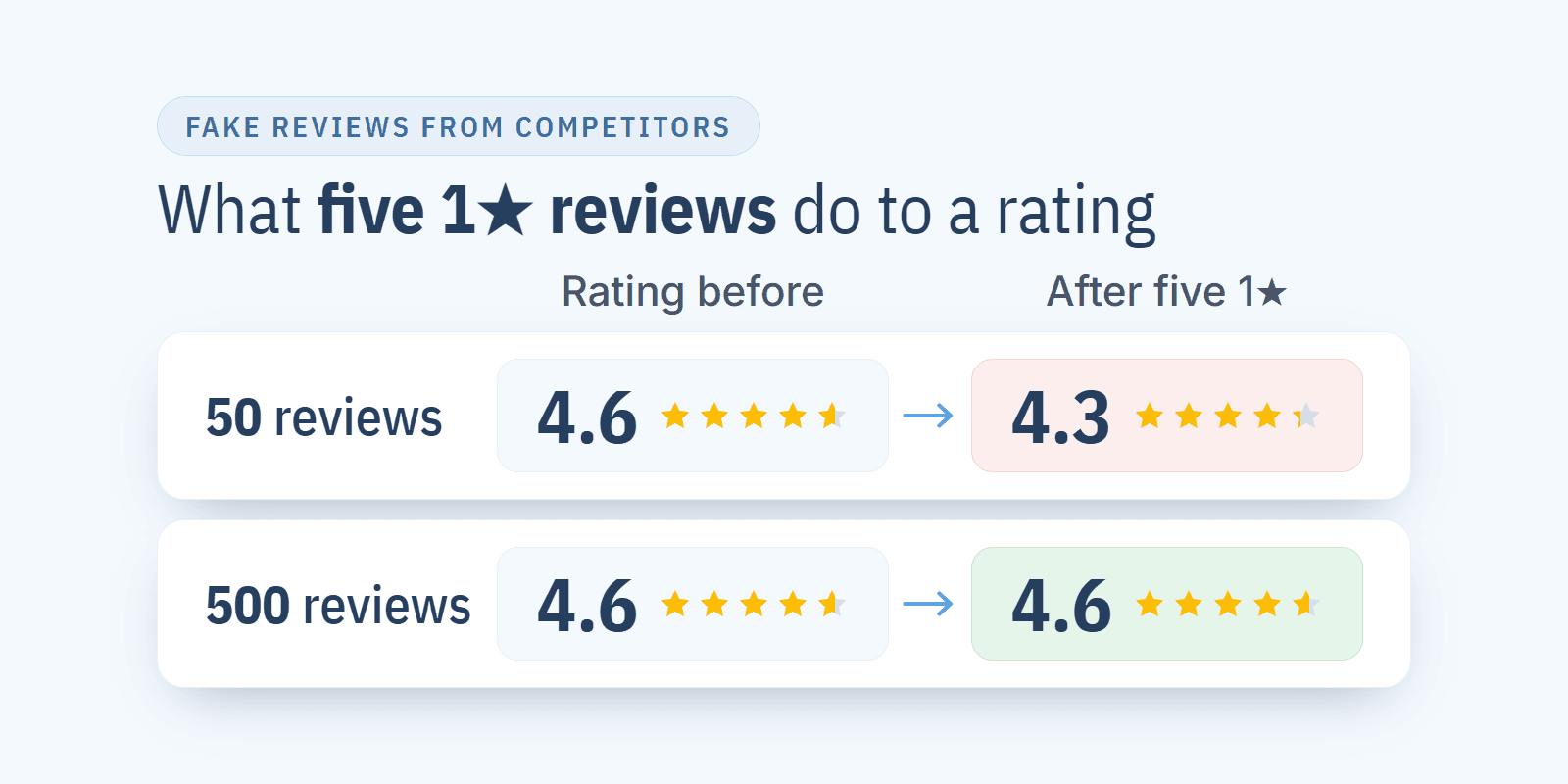
Have plenty of real reviews, because then a wave of fake ones barely moves your average. A clinic with 50 reviews and a 4.6 average gets five 1-star reviews: the average drops to 4.3. A clinic with 500 reviews and the same average still shows 4.6 on Google after the same attack.
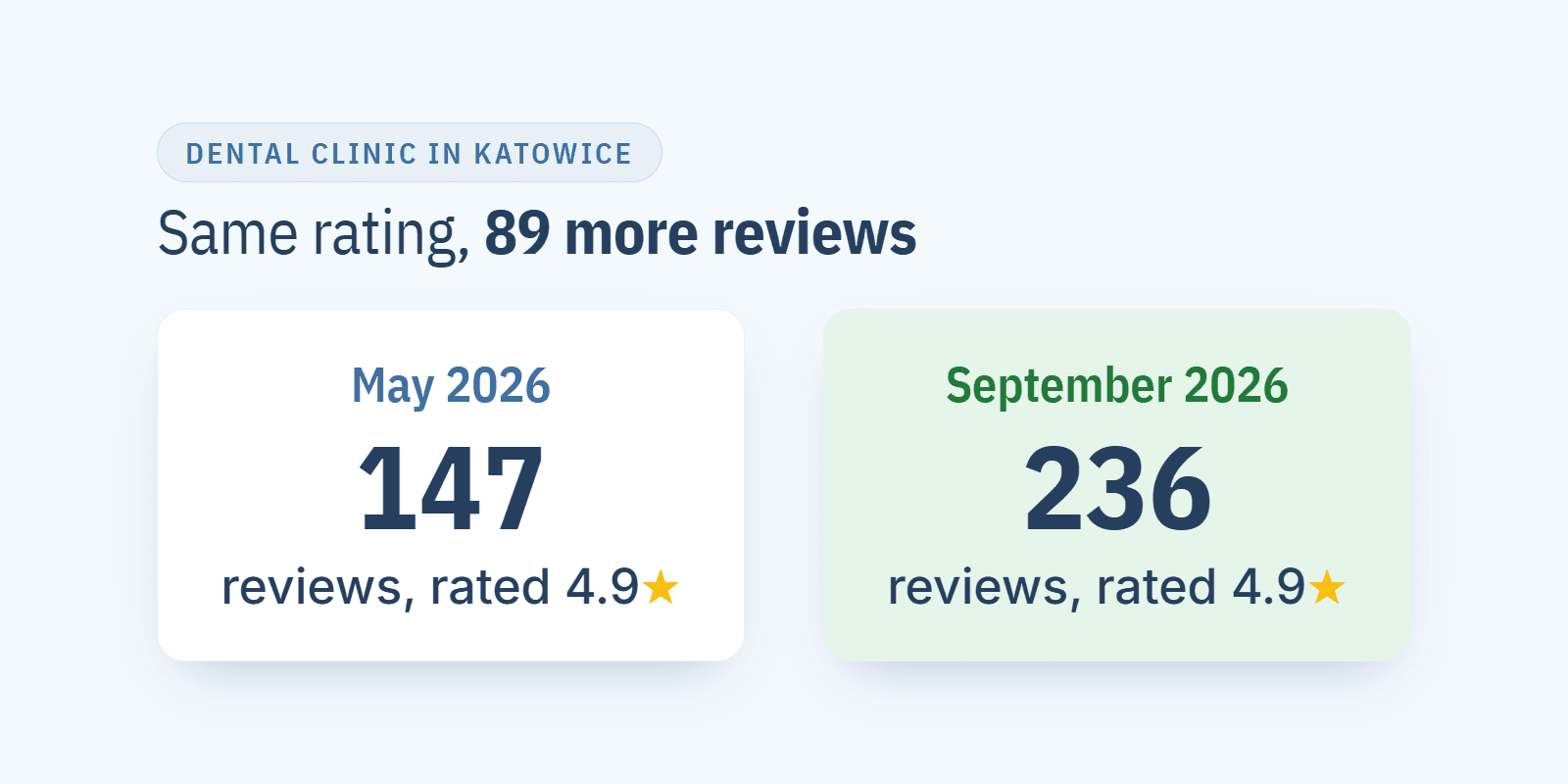
MultiClinic had 166 Google reviews with a 3.7 average, and in under 11 months it gained 1,280 reviews from real patients while the rating at its two clinics rose to 4.7 and 4.8★.
The second part is a fast response: a practice manager who learns about a series of reviews the same day can collect evidence and report them before most patients have read them. All it takes is turning on email notifications for new reviews in your Business Profile settings. To keep track of what people write about your clinic outside Google, use online reputation monitoring.
Repto sends the patient an SMS the day after the visit asking them to rate it. A patient who gives a low rating writes to the clinic first, and the practice manager gets an email and can call them back. How this works in practice is covered in my article on automated Google review collection.
FAQ
What does "black PR" mean?
It's deliberately damaging someone's reputation with false or twisted information, usually from a hidden source. In English it's more often called a smear campaign. Online it takes the form of fake reviews, rumors in groups and posts from fake accounts.
Is a smear campaign legal?
Not when it rests on false claims. In Poland, spreading false information about another business can count as unfair competition, and serious false accusations can also be defamation or a violation of personal rights. Other countries have their own rules, so the details are a question for a local lawyer.
How can you check whether a competitor wrote the fake reviews?
The reviewer's profile tells you the most: the other reviews they've left, a sudden 5★ for a clinic nearby and when the account started posting reviews at all. Real certainty usually comes only once you know who the author is, and getting there is a question for a local lawyer.
How long does Google take to remove a fake review?
Google usually takes a few days to assess a report. If it rejects the report, you get one appeal, in which you can select up to 10 reviews.
Can a clinic reply that the reviewer was never its patient?
No, because that information comes from your patient records, and a clinic can't publicly confirm or deny who its patients are. Under every suspicious review, it's best to leave the same neutral reply with the practice manager's contact details.
How is a smear campaign different from a reputation crisis?
A reputation crisis can be set off by a real event, such as a service failure or a data leak. A smear campaign is a crisis caused on purpose, with false content, so besides a public reply you can also report the reviews to Google, and you have legal options.
Our free Google review calculator shows how many 5★ reviews stand between your clinic and a higher rating. If you have questions about collecting reviews, book a short call with us.